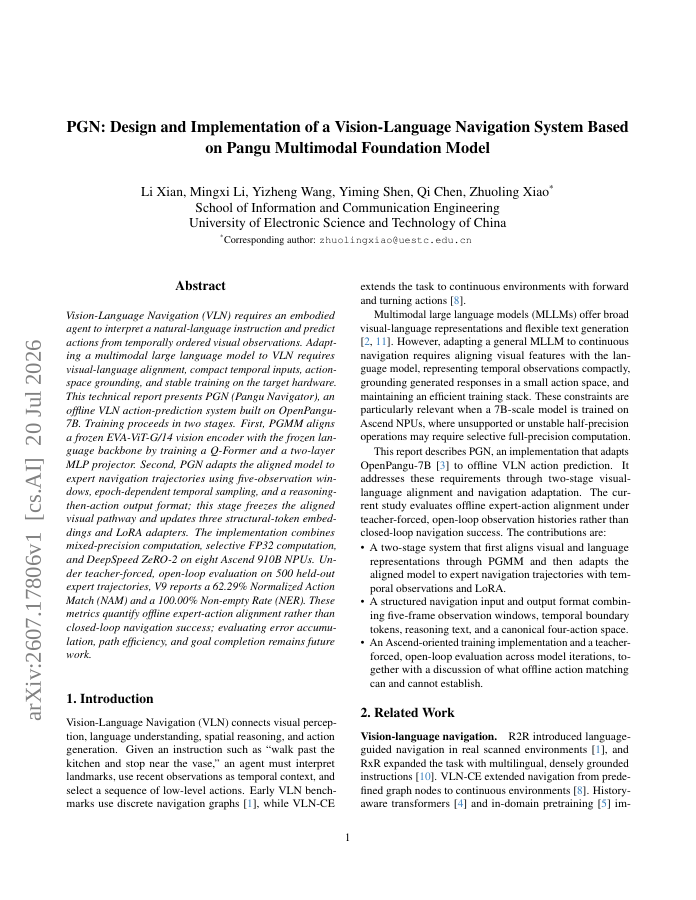
Vision-Language Navigation (VLN) requires an embodied agent to interpret a natural-language instruction and predict actions from temporally ordered visual observations. Adapting a multimodal large language model to VLN requires visual-language alignment, compact temporal inputs, action-space grounding, and stable training on the target hardware. This technical report presents PGN (Pangu Navigator), an offline VLN action-prediction system built on OpenPangu-7B. Training proceeds in two stages. First, PGMM aligns a frozen EVA-ViT-G/14 vision encoder with the frozen language backbone by training a Q-Former and a two-layer MLP projector. Second, PGN adapts the aligned model to expert navigation trajectories using five-observation windows, epoch-dependent temporal sampling, and a reasoning-then-action output format; this stage freezes the aligned visual pathway and updates three structural-token embeddings and LoRA adapters. The implementation combines mixed-precision computation, selective FP32 computation, and DeepSpeed ZeRO-2 on eight Ascend 910B NPUs. Under teacher-forced, open-loop evaluation on 500 held-out expert trajectories, V9 reports a 62.29% Normalized Action Match (NAM) and a 100.00% Non-empty Rate (NER). These metrics quantify offline expert-action alignment rather than closed-loop navigation success; evaluating error accumulation, path efficiency, and goal completion remains future work.
PGN: Design and Implementation of a Vision-Language Navigation System Based on Pangu Multimodal Foundation Model
Vision-Language Navigation (VLN) requires an embodied agent to interpret a natural-language instruction and predict actions from temporally ordered visual observations. Adapting a multimodal large language model to VLN requires visual-language alignment, compact temporal inputs,…
- Preview
- Year
- 2026
- Hosting
- Full text hostedCC-BY-4.0
Cite
Notes
Only stored in your browser.
Attribution
- Abstract & full text
- arxiv.org/abs/2607.17806CC-BY-4.0
- TL;DR
- Semantic Scholar