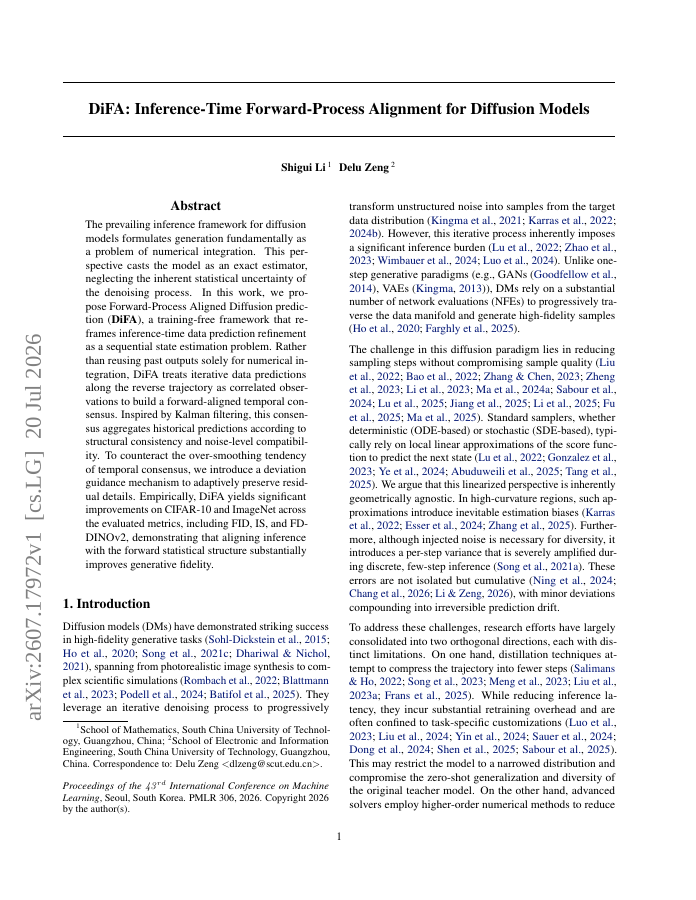
The prevailing inference framework for diffusion models formulates generation fundamentally as a problem of numerical integration. This perspective casts the model as an exact estimator, neglecting the inherent statistical uncertainty of the denoising process. In this work, we propose Forward-Process Aligned Diffusion prediction (DiFA), a training-free framework that reframes inference-time data prediction refinement as a sequential state estimation problem. Rather than reusing past outputs solely for numerical integration, DiFA treats iterative data predictions along the reverse trajectory as correlated observations to build a forward-aligned temporal consensus. Inspired by Kalman filtering, this consensus aggregates historical predictions according to structural consistency and noise-level compatibility. To counteract the over-smoothing tendency of temporal consensus, we introduce a deviation guidance mechanism to adaptively preserve residual details. Empirically, DiFA yields significant improvements on CIFAR-10 and ImageNet across the evaluated metrics, including FID, IS, and FD-DINOv2, demonstrating that aligning inference with the forward statistical structure substantially improves generative fidelity.
DiFA: Inference-Time Forward-Process Alignment for Diffusion Models
The prevailing inference framework for diffusion models formulates generation fundamentally as a problem of numerical integration. This perspective casts the model as an exact estimator, neglecting the inherent statistical uncertainty of the denoising process.
- Preview
- Year
- 2026
- Hosting
- Abstract onlyARXIV-DEFAULT
Cite
Notes
Only stored in your browser.
Attribution
- Abstract & full text
- arxiv.org/abs/2607.17972ARXIV-DEFAULT
- TL;DR
- Semantic Scholar