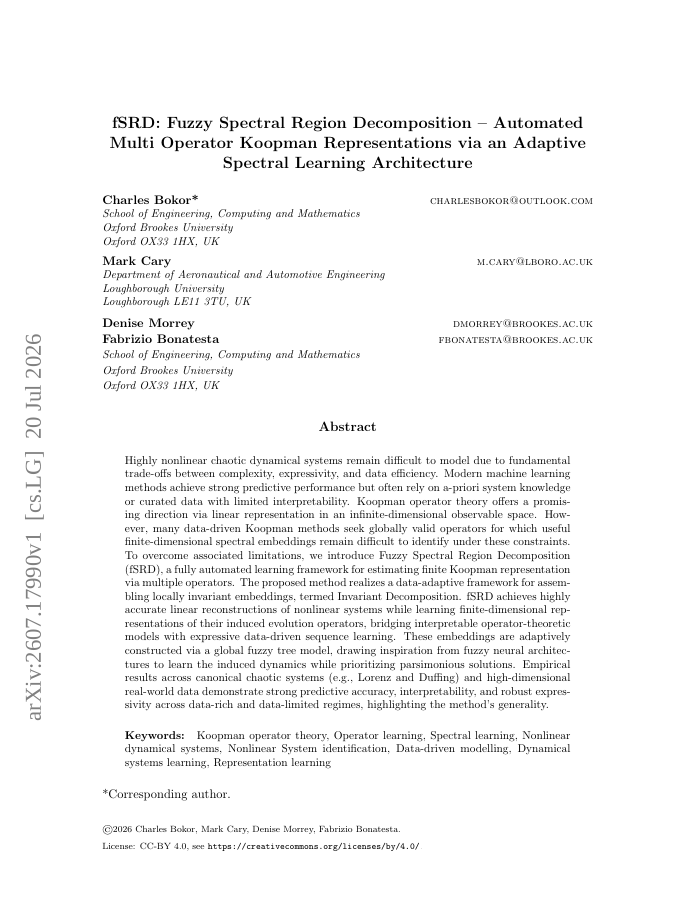
Highly nonlinear chaotic dynamical systems remain difficult to model due to fundamental trade-offs between complexity, expressivity, and data efficiency. Modern machine learning methods achieve strong predictive performance but often rely on a-priori system knowledge or curated data with limited interpretability. Koopman operator theory offers a promising direction via linear representation in an infinite-dimensional observable space. However, many data-driven Koopman methods seek globally valid operators for which useful finite-dimensional spectral embeddings remain difficult to identify under these constraints. To overcome associated limitations, we introduce Fuzzy Spectral Region Decomposition (fSRD), a fully automated learning framework for estimating finite Koopman representation via multiple operators. The proposed method realizes a data-adaptive framework for assembling locally invariant embeddings, termed Invariant Decomposition. fSRD achieves highly accurate linear reconstructions of nonlinear systems while learning finite-dimensional representations of their induced evolution operators, bridging interpretable operator-theoretic models with expressive data-driven sequence learning. These embeddings are adaptively constructed via a global fuzzy tree model, drawing inspiration from fuzzy neural architectures to learn the induced dynamics while prioritizing parsimonious solutions. Empirical results across canonical chaotic systems (e.g., Lorenz and Duffing) and high-dimensional real-world data demonstrate strong predictive accuracy, interpretability, and robust expressivity across data-rich and data-limited regimes, highlighting the method's generality.
fSRD: Fuzzy Spectral Region Decomposition -- Automated Multi Operator Koopman Representations via an Adaptive Spectral Learning Architecture
Highly nonlinear chaotic dynamical systems remain difficult to model due to fundamental trade-offs between complexity, expressivity, and data efficiency. Modern machine learning methods achieve strong predictive performance but often rely on a-priori system knowledge or curated…
- Preview
- Year
- 2026
- Hosting
- Full text hostedCC-BY-4.0
Cite
Notes
Only stored in your browser.
Attribution
- Abstract & full text
- arxiv.org/abs/2607.17990CC-BY-4.0
- TL;DR
- Semantic Scholar