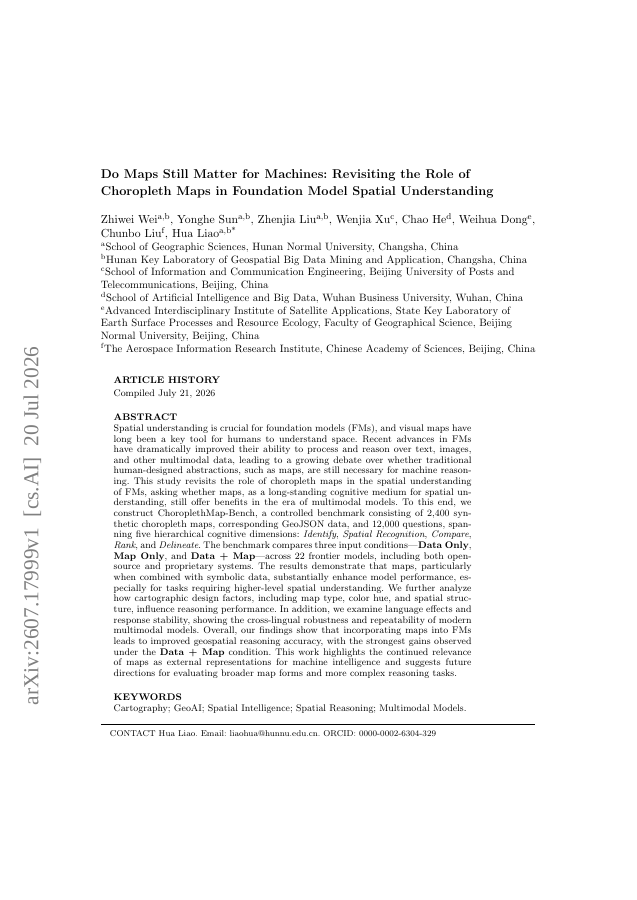
Spatial understanding is crucial for foundation models (FMs), and maps have long helped humans organize and reason about geographic information. This study examines whether choropleth maps remain useful for machine spatial understanding when models can directly process structured geodata. We introduce ChoroplethMap-Bench, a controlled benchmark containing 2,400 synthetic choropleth maps, corresponding GeoJSON data, and 12,000 questions across five cognitive dimensions: Identify, Spatial Recognition, Compare, Rank, and Delineate. We evaluate 22 open-source and proprietary models under three input conditions: Data Only, Map Only, and Data + Map. The results show that maps substantially improve spatial reasoning, especially when combined with symbolic data and for tasks requiring higher-level understanding of spatial patterns. We further analyze the effects of map type, color hue, and spatial structure, as well as prompting strategies, language, geographic context, decoding settings, classification methods, and response stability. Overall, the Data + Map condition achieves the strongest performance, demonstrating that maps remain valuable external representations for foundation model spatial reasoning.
Do Maps Still Matter for Machines: Revisiting the Role of Choropleth Maps in Foundation Model Spatial Understanding
Spatial understanding is crucial for foundation models (FMs), and maps have long helped humans organize and reason about geographic information. This study examines whether choropleth maps remain useful for machine spatial understanding when models can directly process…
- Preview
- Year
- 2026
- Hosting
- Abstract onlyARXIV-DEFAULT
Cite
Notes
Only stored in your browser.
Attribution
- Abstract & full text
- arxiv.org/abs/2607.17999ARXIV-DEFAULT
- TL;DR
- Semantic Scholar