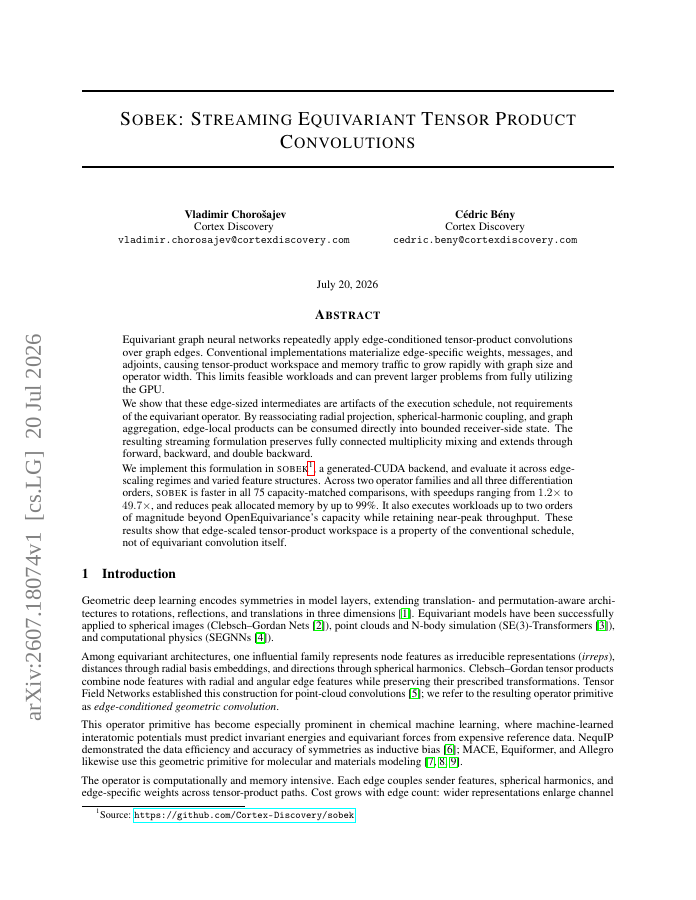
Equivariant graph neural networks repeatedly apply edge-conditioned tensor-product convolutions over graph edges. Conventional implementations materialize edge-specific weights, messages, and adjoints, causing tensor-product workspace and memory traffic to grow rapidly with graph size and operator width. This limits feasible workloads and can prevent larger problems from fully utilizing the GPU. We show that these edge-sized intermediates are artifacts of the execution schedule, not requirements of the equivariant operator. By reassociating radial projection, spherical-harmonic coupling, and graph aggregation, edge-local products can be consumed directly into bounded receiver-side state. The resulting streaming formulation preserves fully connected multiplicity mixing and extends through forward, backward, and double backward. We implement this formulation in Sobek, a generated-CUDA backend, and evaluate it across edge-scaling regimes and varied feature structures. Across two operator families and all three differentiation orders, Sobek is faster in all 75 capacity-matched comparisons, with speedups ranging from 1.2\times to 49.7\times, and reduces peak allocated memory by up to 99%. It also executes workloads up to two orders of magnitude beyond OpenEquivariance's capacity while retaining near-peak throughput. These results show that edge-scaled tensor-product workspace is a property of the conventional schedule, not of equivariant convolution itself.
Sobek: Streaming Equivariant Tensor Product Convolutions
Equivariant graph neural networks repeatedly apply edge-conditioned tensor-product convolutions over graph edges. Conventional implementations materialize edge-specific weights, messages, and adjoints, causing tensor-product workspace and memory traffic to grow rapidly with…
- Preview
- Year
- 2026
- Hosting
- Abstract onlyARXIV-DEFAULT
Cite
Notes
Only stored in your browser.
Attribution
- Abstract & full text
- arxiv.org/abs/2607.18074ARXIV-DEFAULT
- TL;DR
- Semantic Scholar