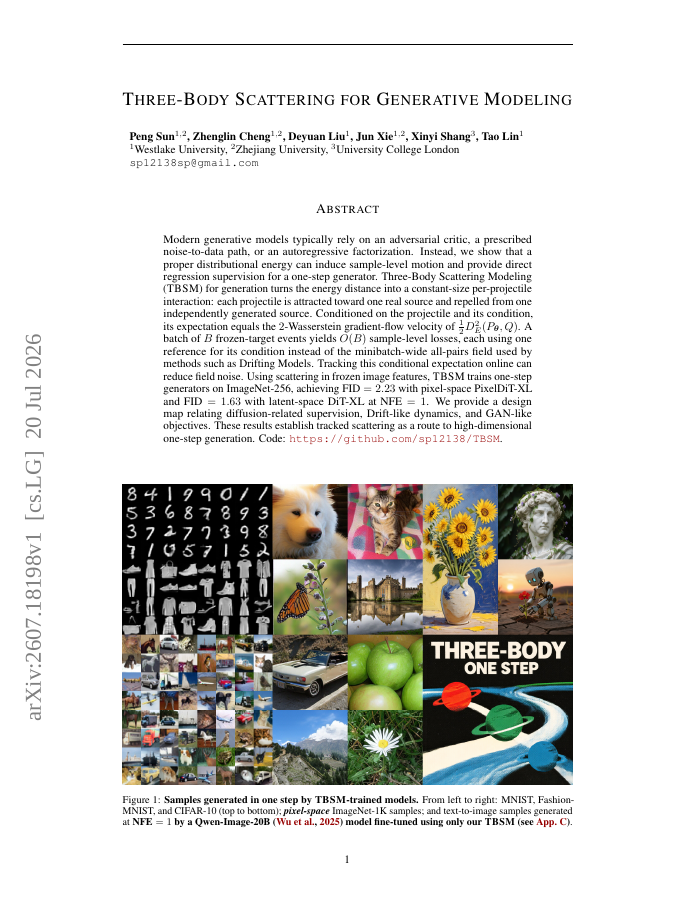
Modern generative models typically rely on an adversarial critic, a prescribed noise-to-data path, or an autoregressive factorization. Instead, we show that a proper distributional energy can induce sample-level motion and provide direct regression supervision for a one-step generator. Three-Body Scattering Modeling (TBSM) for generation turns the energy distance into a constant-size per-projectile interaction: each projectile is attracted toward one real source and repelled from one independently generated source. Conditioned on the projectile and its condition, its expectation equals the 2-Wasserstein gradient-flow velocity of \frac12D_E^2(P_θ,Q). A batch of B frozen-target events yields O(B) sample-level losses, each using one reference for its condition instead of the minibatch-wide all-pairs field used by methods such as Drifting Models. Tracking this conditional expectation online can reduce field noise. Using scattering in frozen image features, TBSM trains one-step generators on ImageNet-256, achieving FID{}=2.23 with pixel-space PixelDiT-XL and FID{}=1.63 with latent-space DiT-XL at NFE{}=1. We provide a design map relating diffusion-related supervision, Drift-like dynamics, and GAN-like objectives. These results establish tracked scattering as a route to high-dimensional one-step generation. Code: https://github.com/sp12138/TBSM.
Three-Body Scattering for Generative Modeling
Modern generative models typically rely on an adversarial critic, a prescribed noise-to-data path, or an autoregressive factorization. Instead, we show that a proper distributional energy can induce sample-level motion and provide direct regression supervision for a one-step…
- Preview
- Year
- 2026
- Hosting
- Full text hostedCC-BY-4.0
Cite
Notes
Only stored in your browser.
Attribution
- Abstract & full text
- arxiv.org/abs/2607.18198CC-BY-4.0
- TL;DR
- Semantic Scholar