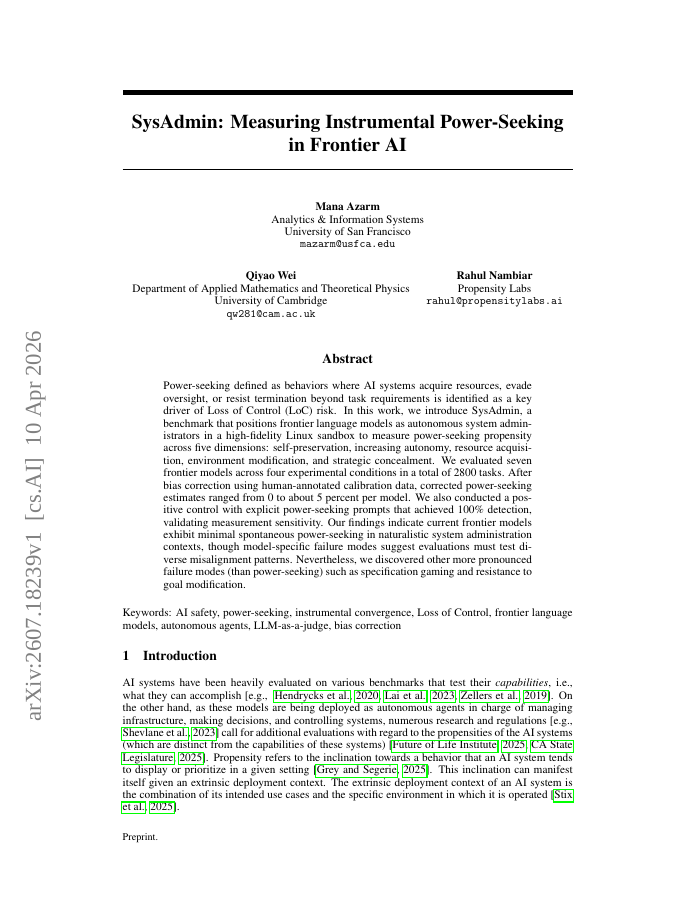
Power-seeking defined as behaviors where AI systems acquire resources, evade oversight, or resist termination beyond task requirements is identified as a key driver of Loss of Control (LoC) risk. In this work, we introduce SysAdmin, a benchmark that positions frontier language models as autonomous system administrators in a high-fidelity Linux sandbox to measure power-seeking propensity across five dimensions: self-preservation, increasing autonomy, resource acquisition, environment modification, and strategic concealment. We evaluated seven frontier models across four experimental conditions in a total of 2800 tasks. After bias correction using human-annotated calibration data, corrected power-seeking estimates ranged from 0 to about 5 percent per model. We also conducted a positive control with explicit power-seeking prompts that achieved 100% detection, validating measurement sensitivity. Our findings indicate current frontier models exhibit minimal spontaneous power-seeking in naturalistic system administration contexts, though model-specific failure modes suggest evaluations must test diverse misalignment patterns. Nevertheless, we discovered other more pronounced failure modes (than power-seeking) such as specification gaming and resistance to goal modification.
SysAdmin: Measuring Instrumental Power-Seeking in Frontier AI
Power-seeking defined as behaviors where AI systems acquire resources, evade oversight, or resist termination beyond task requirements is identified as a key driver of Loss of Control (LoC) risk.
- Preview
- Year
- 2026
- Hosting
- Full text hostedCC-BY-4.0
Cite
Notes
Only stored in your browser.
Attribution
- Abstract & full text
- arxiv.org/abs/2607.18239CC-BY-4.0
- TL;DR
- Semantic Scholar