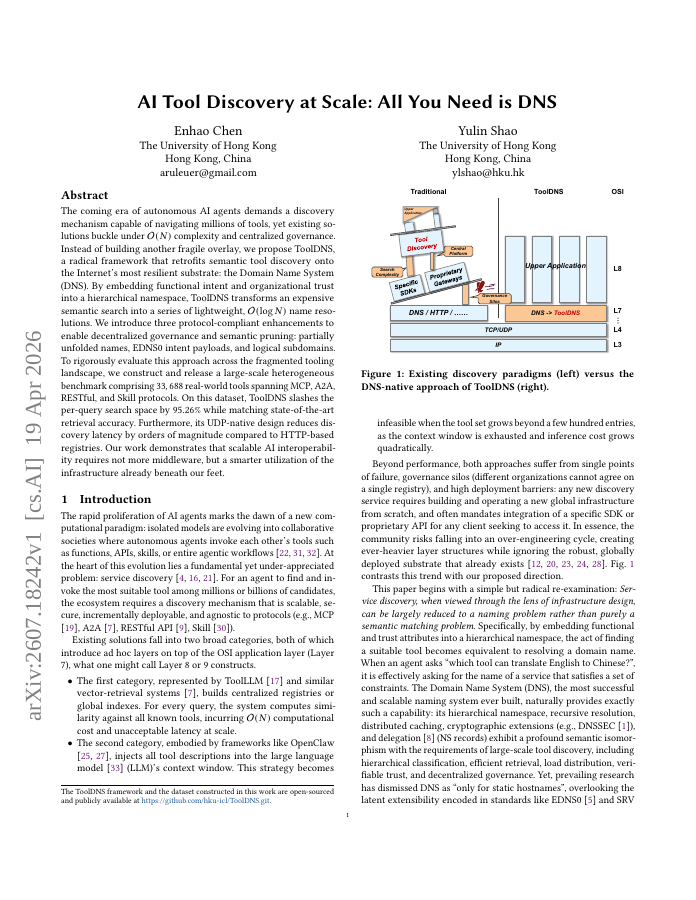
The coming era of autonomous AI agents demands a discovery mechanism capable of navigating millions of tools, yet existing solutions buckle under O(N) complexity and centralized governance. Instead of building another fragile overlay, we propose ToolDNS, a radical framework that retrofits semantic tool discovery onto the Internet's most resilient substrate: the Domain Name System (DNS). By embedding functional intent and organizational trust into a hierarchical namespace, ToolDNS transforms an expensive semantic search into a series of lightweight, O(log N) name resolutions. We introduce three protocol-compliant enhancements to enable decentralized governance and semantic pruning: partially unfolded names, EDNS0 intent payloads, and logical subdomains. To rigorously evaluate this approach across the fragmented tooling landscape, we construct and release a large-scale heterogeneous benchmark comprising 33,688 real-world tools spanning MCP, A2A, RESTful, and Skill protocols. On this dataset, ToolDNS slashes the per-query search space by 95.26% while matching state-of-the-art retrieval accuracy. Furthermore, its UDP-native design reduces discovery latency by orders of magnitude compared to HTTP-based registries. Our work demonstrates that scalable AI interoperability requires not more middleware, but a smarter utilization of the infrastructure already beneath our feet.
AI Tool Discovery at Scale: All You Need is DNS
The coming era of autonomous AI agents demands a discovery mechanism capable of navigating millions of tools, yet existing solutions buckle under O(N) complexity and centralized governance.
- Preview
- Year
- 2026
- Hosting
- Abstract onlyARXIV-DEFAULT
Cite
Notes
Only stored in your browser.
Attribution
- Abstract & full text
- arxiv.org/abs/2607.18242ARXIV-DEFAULT
- TL;DR
- Semantic Scholar