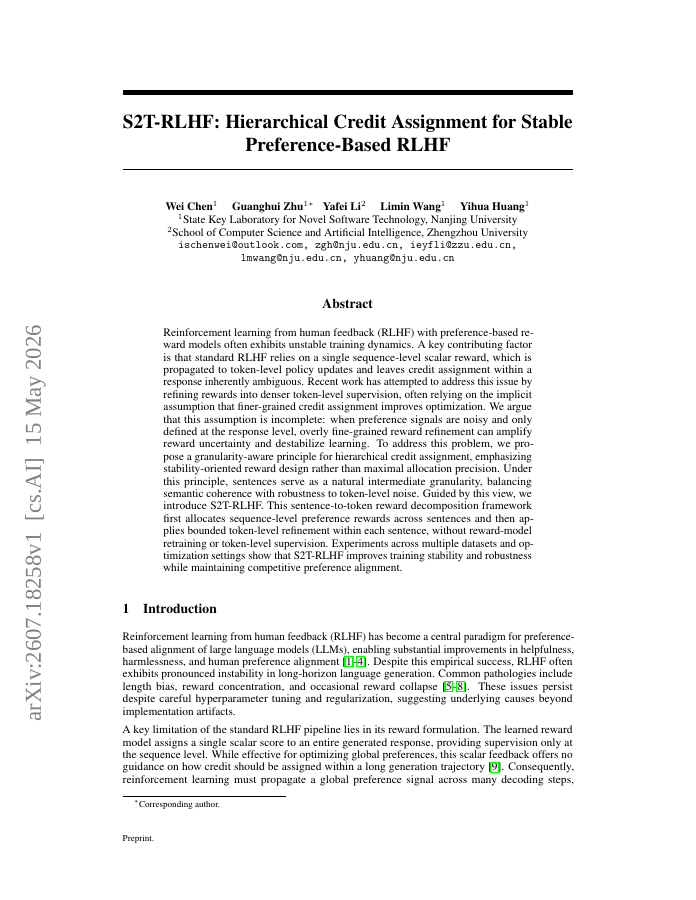
Reinforcement learning from human feedback (RLHF) with preference-based reward models often exhibits unstable training dynamics. A key contributing factor is that standard RLHF relies on a single sequence-level scalar reward, which is propagated to token-level policy updates and leaves credit assignment within a response inherently ambiguous. Recent work has attempted to address this issue by refining rewards into denser token-level supervision, often relying on the implicit assumption that finer-grained credit assignment improves optimization. We argue that this assumption is incomplete: when preference signals are noisy and only defined at the response level, overly fine-grained reward refinement can amplify reward uncertainty and destabilize learning. To address this problem, we propose a granularity-aware principle for hierarchical credit assignment, emphasizing stability-oriented reward design rather than maximal allocation precision. Under this principle, sentences serve as a natural intermediate granularity, balancing semantic coherence with robustness to token-level noise. Guided by this view, we introduce S2T-RLHF. This sentence-to-token reward decomposition framework first allocates sequence-level preference rewards across sentences and then applies bounded token-level refinement within each sentence, without reward-model retraining or token-level supervision. Experiments across multiple datasets and optimization settings show that S2T-RLHF improves training stability and robustness while maintaining competitive preference alignment.
S2T-RLHF: Hierarchical Credit Assignment for Stable Preference-Based RLHF
Reinforcement learning from human feedback (RLHF) with preference-based reward models often exhibits unstable training dynamics. A key contributing factor is that standard RLHF relies on a single sequence-level scalar reward, which is propagated to token-level policy updates and…
- Preview
- Year
- 2026
- Hosting
- Full text hostedCC-BY-4.0
Cite
Notes
Only stored in your browser.
Attribution
- Abstract & full text
- arxiv.org/abs/2607.18258CC-BY-4.0
- TL;DR
- Semantic Scholar