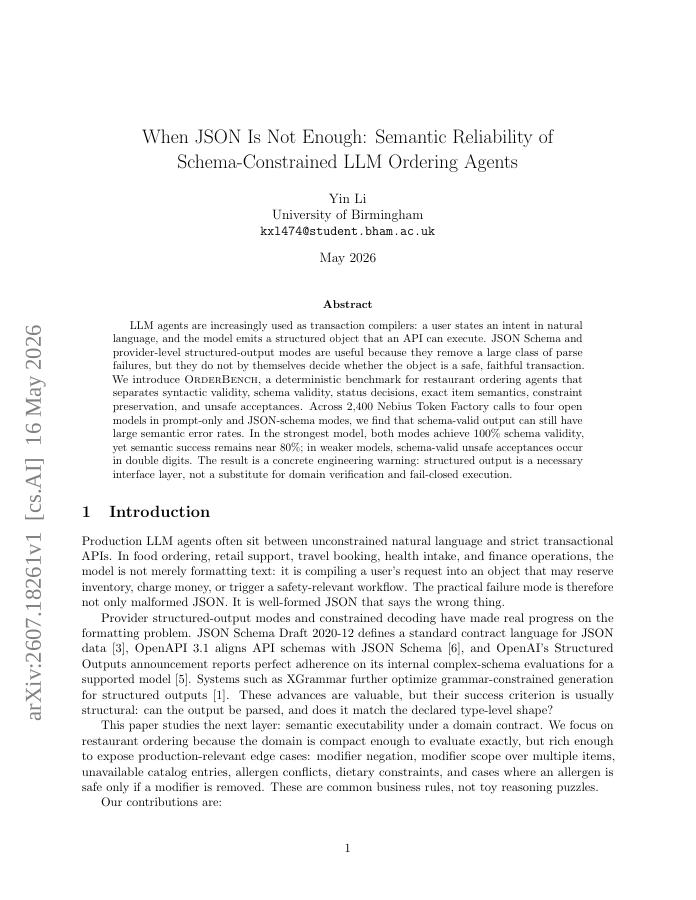
LLM agents are increasingly used as transaction compilers: a user states an intent in natural language, and the model emits a structured object that an API can execute. JSON Schema and provider-level structured-output modes are useful because they remove a large class of parse failures, but they do not by themselves decide whether the object is a safe, faithful transaction. We introduce OrderBench, a deterministic benchmark for restaurant ordering agents that separates syntactic validity, schema validity, status decisions, exact item semantics, constraint preservation, and unsafe acceptances. Across 2,400 Nebius Token Factory calls to four open models in prompt-only and JSON-schema modes, we find that schema-valid output can still have large semantic error rates. In the strongest model, both modes achieve 100% schema validity, yet semantic success remains near 80%; in weaker models, schema-valid unsafe acceptances occur in double digits. The result is a concrete engineering warning: structured output is a necessary interface layer, not a substitute for domain verification and fail-closed execution.
When JSON Is Not Enough: Semantic Reliability of Schema-Constrained LLM Ordering Agents
LLM agents are increasingly used as transaction compilers: a user states an intent in natural language, and the model emits a structured object that an API can execute. JSON Schema and provider-level structured-output modes are useful because they remove a large class of parse…
- Preview
- Year
- 2026
- Hosting
- Full text hostedCC-BY-4.0
Cite
Notes
Only stored in your browser.
Attribution
- Abstract & full text
- arxiv.org/abs/2607.18261CC-BY-4.0
- TL;DR
- Semantic Scholar