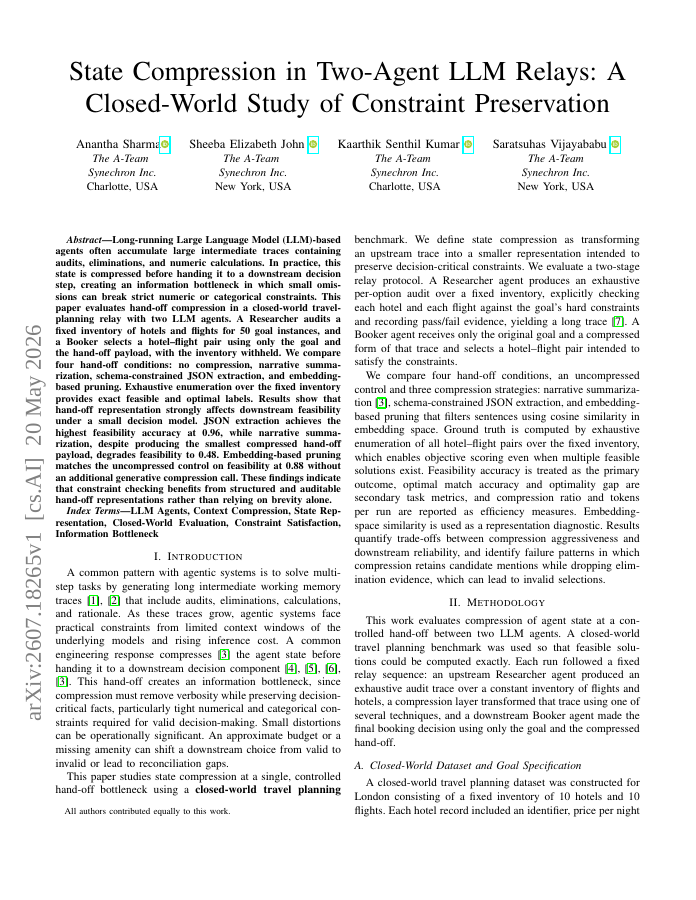
Long-running Large Language Model (LLM)-based agents often accumulate large intermediate traces containing audits, eliminations, and numeric calculations. In practice, this state is compressed before handing it to a downstream decision step, creating an information bottleneck in which small omissions can break strict numeric or categorical constraints. This paper evaluates hand-off compression in a closed-world travel-planning relay with two LLM agents. A Researcher audits a fixed inventory of hotels and flights for 50 goal instances, and a Booker selects a hotel--flight pair using only the goal and the hand-off payload, with the inventory withheld. We compare four hand-off conditions: no compression, narrative summarization, schema-constrained JSON extraction, and embedding-based pruning. Exhaustive enumeration over the fixed inventory provides exact feasible and optimal labels. Results show that hand-off representation strongly affects downstream feasibility under a small decision model. JSON extraction achieves the highest feasibility accuracy at 0.96, while narrative summarization, despite producing the smallest compressed hand-off payload, degrades feasibility to 0.48. Embedding-based pruning matches the uncompressed control on feasibility at 0.88 without an additional generative compression call. These findings indicate that constraint checking benefits from structured and auditable hand-off representations rather than relying on brevity alone.
State Compression in Two-Agent LLM Relays: A Closed-World Study of Constraint Preservation
Long-running Large Language Model (LLM)-based agents often accumulate large intermediate traces containing audits, eliminations, and numeric calculations. In practice, this state is compressed before handing it to a downstream decision step, creating an information bottleneck in…
- Preview
- Year
- 2026
- Hosting
- Excerpt onlyCC-BY-NC-4.0
Cite
Notes
Only stored in your browser.
Attribution
- Abstract & full text
- arxiv.org/abs/2607.18265CC-BY-NC-4.0
- TL;DR
- Semantic Scholar