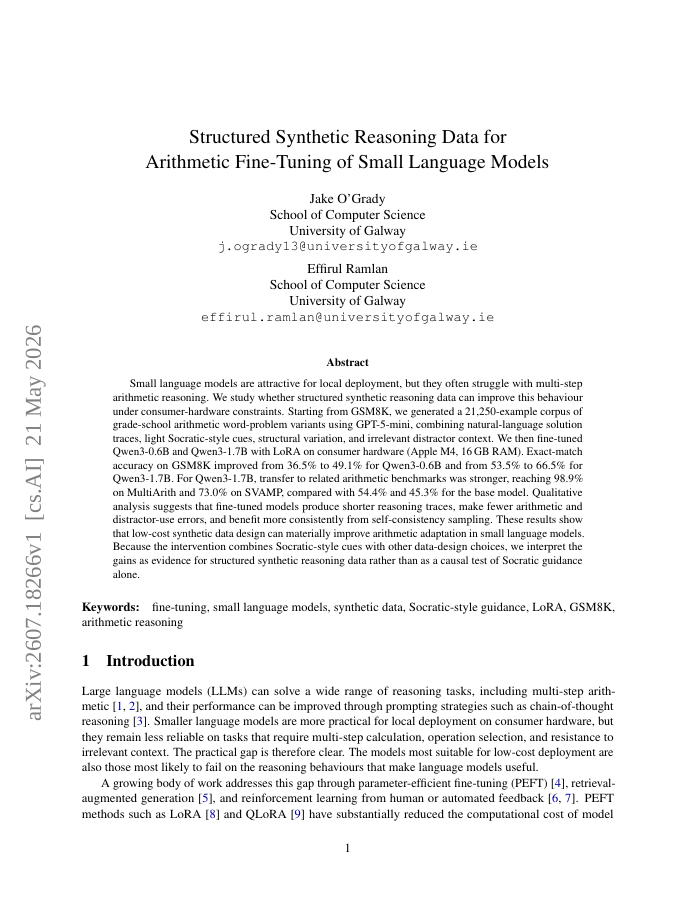
Small language models are attractive for local deployment, but they often struggle with multi-step arithmetic reasoning. We study whether structured synthetic reasoning data can improve this behaviour under consumer-hardware constraints. Starting from GSM8K, we generated a 21,250-example corpus of grade-school arithmetic word-problem variants using GPT-5-mini, combining natural-language solution traces, light Socratic-style cues, structural variation, and irrelevant distractor context. We then fine-tuned Qwen3-0.6B and Qwen3-1.7B with LoRA on consumer hardware (Apple M4, 16 GB RAM). Exact-match accuracy on GSM8K improved from 36.5% to 49.1% for Qwen3-0.6B and from 53.5% to 66.5% for Qwen3-1.7B. For Qwen3-1.7B, transfer to related arithmetic benchmarks was stronger, reaching 98.9% on MultiArith and 73.0% on SVAMP, compared with 54.4% and 45.3% for the base model. Qualitative analysis suggests that fine-tuned models produce shorter reasoning traces, make fewer arithmetic and distractor-use errors, and benefit more consistently from self-consistency sampling. These results show that low-cost synthetic data design can materially improve arithmetic adaptation in small language models. Because the intervention combines Socratic-style cues with other data-design choices, we interpret the gains as evidence for structured synthetic reasoning data rather than as a causal test of Socratic guidance alone.
Structured Synthetic Reasoning Data for Arithmetic Fine-Tuning of Small Language Models
Small language models are attractive for local deployment, but they often struggle with multi-step arithmetic reasoning. We study whether structured synthetic reasoning data can improve this behaviour under consumer-hardware constraints.
- Preview
- Year
- 2026
- Hosting
- Excerpt onlyCC-BY-NC-SA-4.0
Cite
Notes
Only stored in your browser.
Attribution
- Abstract & full text
- arxiv.org/abs/2607.18266CC-BY-NC-SA-4.0
- TL;DR
- Semantic Scholar