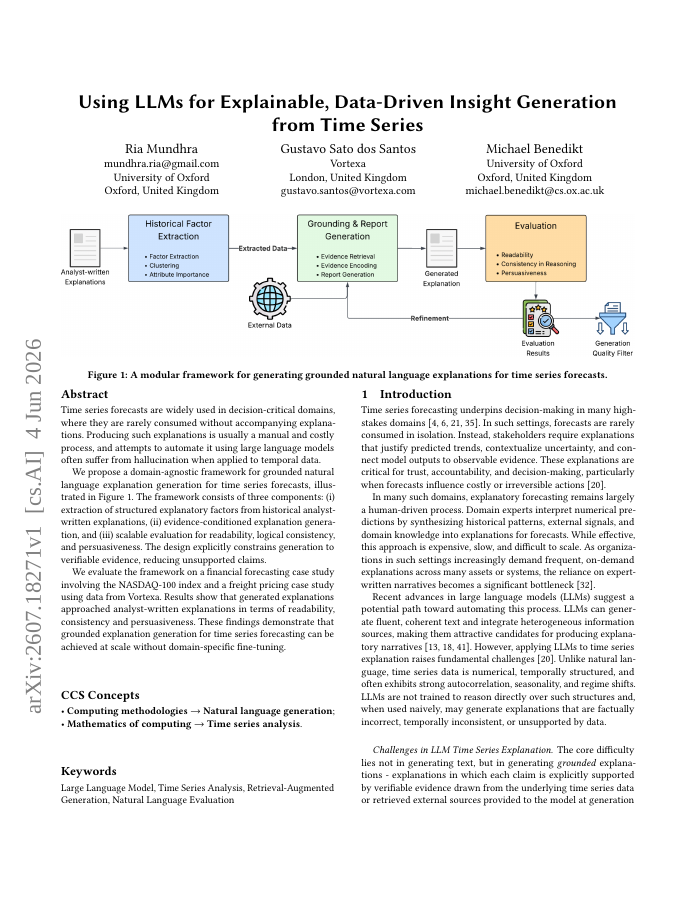
Time series forecasts are widely used in decision-critical domains, where they are rarely consumed without accompanying explanations. Producing such explanations is usually a manual and costly process, and attempts to automate it using large language models often suffer from hallucination when applied to temporal data. We propose a domain-agnostic framework for grounded natural language explanation generation for time series forecasts, illustrated in Figure 1. The framework consists of three components: (i) extraction of structured explanatory factors from historical analyst-written explanations, (ii) evidence-conditioned explanation generation, and (iii) scalable evaluation for readability, logical consistency, and persuasiveness. The design explicitly constrains generation to verifiable evidence, reducing unsupported claims. We evaluate the framework on a financial forecasting case study involving the NASDAQ-100 index and a freight pricing case study using data from Vortexa. Results show that generated explanations approached analyst-written explanations in terms of readability, consistency and persuasiveness. These findings demonstrate that grounded explanation generation for time series forecasting can be achieved at scale without domain-specific fine-tuning.
Using LLMs for Explainable, Data-Driven Insight Generation from Time Series
Time series forecasts are widely used in decision-critical domains, where they are rarely consumed without accompanying explanations. Producing such explanations is usually a manual and costly process, and attempts to automate it using large language models often suffer from…
- Preview
- Year
- 2026
- Hosting
- Full text hostedCC-BY-4.0
Cite
Notes
Only stored in your browser.
Attribution
- Abstract & full text
- arxiv.org/abs/2607.18271CC-BY-4.0
- TL;DR
- Semantic Scholar