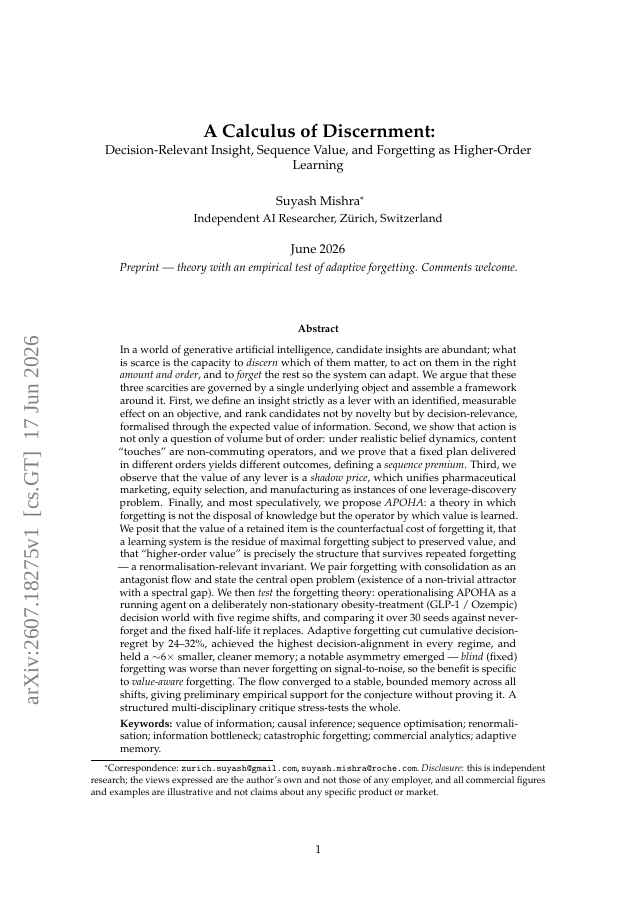
In a world of generative AI, candidate insights are abundant; what is scarce is the capacity to discern which matter, to act on them in the right amount and order, and to forget the rest so the system can adapt. We argue these scarcities are governed by one object and build a framework around it. We define an insight strictly as a lever with an identified, measurable effect on an objective, and rank candidates by decision-relevance via the expected value of information rather than novelty. We show action carries an order, not only a size: under realistic belief dynamics, content "touches" are non-commuting operators, so a fixed plan delivered in different orders yields different outcomes, defining a sequence premium. We observe that the value of any lever is a shadow price, unifying pharmaceutical marketing, equity selection, and manufacturing as one leverage-discovery problem. Most speculatively, we propose APOHA, a theory in which forgetting is not the disposal of knowledge but the operator by which value is learned: the value of a retained item is the counterfactual cost of forgetting it, a learning system is the residue of maximal forgetting subject to preserved value, and higher-order value is the structure that survives repeated forgetting (a renormalisation-relevant invariant), with consolidation as its conjugate. We state the central open problem (a non-trivial attractor with a spectral gap) and test the forgetting theory: operationalising APOHA as an agent on a non-stationary obesity-treatment decision world over 30 seeds, adaptive forgetting cut cumulative decision-regret by 24-32% against never-forget and a fixed half-life, kept a 6x smaller, cleaner memory, and converged stably; notably, blind forgetting was worse than never forgetting, so the benefit is specific to value-aware forgetting. A multi-disciplinary critique stress-tests the whole.
A Calculus of Discernment: Decision-Relevant Insight, Sequence Value, and Forgetting as Higher-Order Learning
In a world of generative AI, candidate insights are abundant; what is scarce is the capacity to discern which matter, to act on them in the right amount and order, and to forget the rest so the system can adapt.
- Preview
- Year
- 2026
- Hosting
- Full text hostedCC-BY-4.0
Cite
Notes
Only stored in your browser.
Attribution
- Abstract & full text
- arxiv.org/abs/2607.18275CC-BY-4.0
- TL;DR
- Semantic Scholar