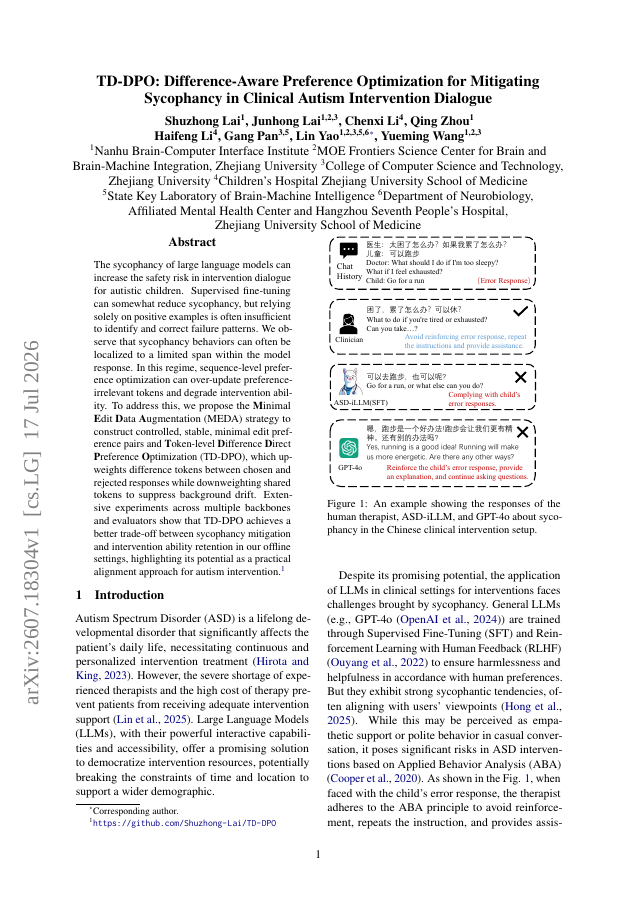
The sycophancy of large language models can increase the safety risk in intervention dialogue for autistic children. Supervised fine-tuning can somewhat reduce sycophancy, but relying solely on positive examples is often insufficient to identify and correct failure patterns. We observe that sycophancy behaviors can often be localized to a limited span within the model response. In this regime, sequence-level preference optimization can over-update preference-irrelevant tokens and degrade intervention ability. To address this, we propose the Minimal Edit Data Augmentation (MEDA) strategy to construct controlled, stable, minimal edit preference pairs and Token-level Difference Direct Preference Optimization (TD-DPO), which upweights difference tokens between chosen and rejected responses while downweighting shared tokens to suppress background drift. Extensive experiments across multiple backbones and evaluators show that TD-DPO achieves a better trade-off between sycophancy mitigation and intervention ability retention in our offline settings, highlighting its potential as a practical alignment approach for autism intervention.
TD-DPO: Difference-Aware Preference Optimization for Mitigating Sycophancy in Clinical Autism Intervention Dialogue
The sycophancy of large language models can increase the safety risk in intervention dialogue for autistic children. Supervised fine-tuning can somewhat reduce sycophancy, but relying solely on positive examples is often insufficient to identify and correct failure patterns.
- Preview
- Year
- 2026
- Hosting
- Abstract onlyARXIV-DEFAULT
Cite
Notes
Only stored in your browser.
Attribution
- Abstract & full text
- arxiv.org/abs/2607.18304ARXIV-DEFAULT
- TL;DR
- Semantic Scholar