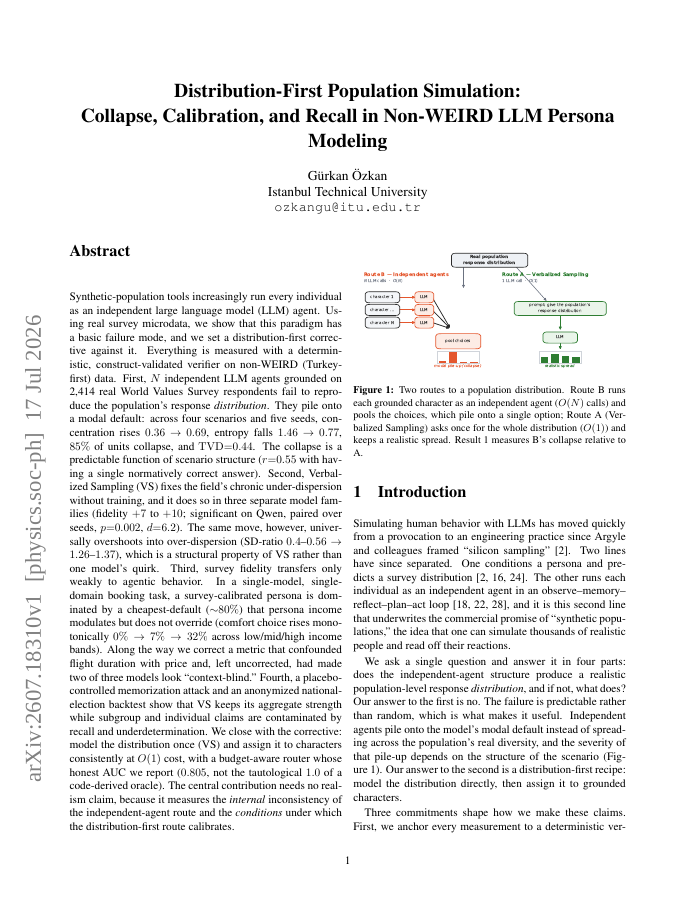
Synthetic-population tools increasingly run every individual as an independent large language model (LLM) agent. Using real survey microdata, we show that this paradigm has a basic failure mode, and we set a distribution-first corrective against it, all measured with a deterministic, construct-validated verifier on non-WEIRD (Turkey-first) data. First, N independent LLM agents grounded on 2,414 real World Values Survey respondents fail to reproduce the population's response distribution: they pile onto a modal default (four scenarios x five seeds: concentration 0.36->0.69, entropy 1.46->0.77, 85% collapse, TVD=0.44), and the collapse is a predictable function of scenario structure (r=0.55 with a single-answer structure). Second, Verbalized Sampling (VS) fixes the field's chronic under-dispersion without training in three model families (fidelity +7 to +10; significant on Qwen, p=0.002, d=6.2), yet the same move universally overshoots into over-dispersion (SD-ratio 0.4-0.56 -> 1.26-1.37), a structural property of VS. Third, survey fidelity transfers only weakly to agentic behavior: in a single-model, single-domain booking task, a persona is dominated by a cheapest-default ( 80%) that income modulates but does not override (comfort choice 0%->7%->32% across income bands). Fourth, a placebo-controlled memorization attack and an election backtest show VS keeps aggregate strength while subgroup and individual claims are contaminated by recall and underdetermination. We close with the corrective: model the distribution once (VS) and assign it to grounded characters at O(1) cost, with a budget-aware router whose honest AUC is 0.805, not the tautological 1.0 of a code-derived oracle. The central contribution needs no realism claim: it measures the internal inconsistency of the independent-agent route and the conditions under which the distribution-first route calibrates.
Distribution-First Population Simulation: Collapse, Calibration, and Recall in Non-WEIRD LLM Persona Modeling
Synthetic-population tools increasingly run every individual as an independent large language model (LLM) agent. Using real survey microdata, we show that this paradigm has a basic failure mode, and we set a distribution-first corrective against it, all measured with a…
- Preview
- Year
- 2026
- Hosting
- Full text hostedCC-BY-4.0
Cite
Notes
Only stored in your browser.
Attribution
- Abstract & full text
- arxiv.org/abs/2607.18310CC-BY-4.0
- TL;DR
- Semantic Scholar