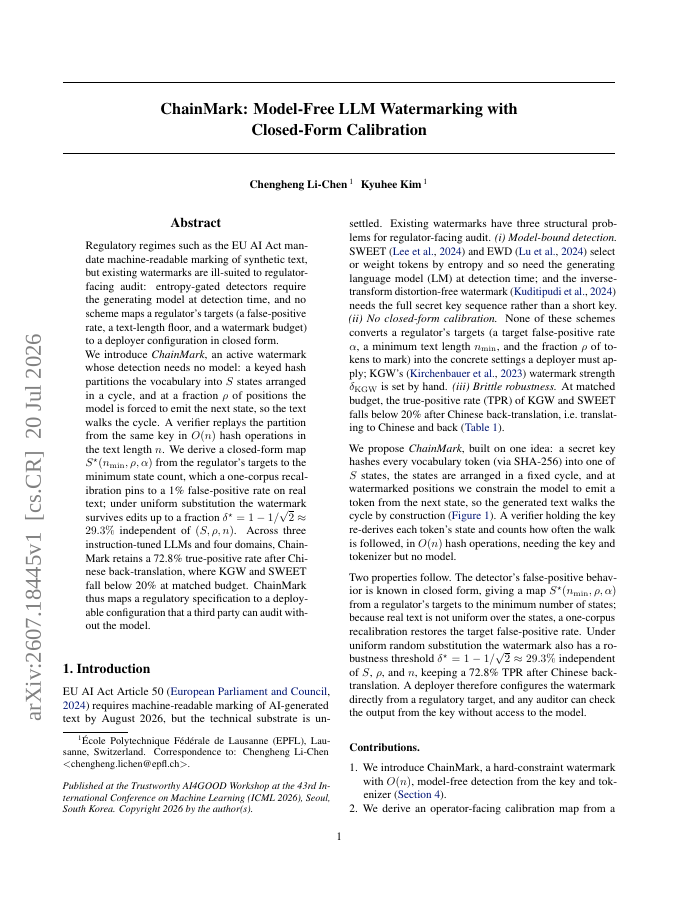
Regulatory regimes such as the EU AI Act mandate machine-readable marking of synthetic text, but existing watermark detectors rely on the generating LM and on heuristic thresholds with no closed-form calibration. We introduce ChainMark, an active watermark that partitions the vocabulary into S states via keyed SHA-256 and forces a hard Markov transition on a fraction rho of positions; the detector replays the partition from the same key in O(n) hash operations, with no LM access. We derive a closed-form S*(n, rho, alpha) mapping a target FPR, text length, and budget to the minimum state count (Theorem 1), prove a universal robustness threshold delta* = 1 - 1/sqrt(2) approximately 29.3% that is invariant in (S, rho, n) (Theorem 2), and generalise both to any k-regular transition topology (Theorem 3). Across three instruction-tuned LLMs and four domains, ChainMark strictly dominates KGW and SWEET under translation and random-substitution attacks at matched budget; a one-corpus empirical recalibration restores the 1% target FPR on natural-language text.
ChainMark: Model-Free LLM Watermarking with Closed-Form Calibration
Regulatory regimes such as the EU AI Act mandate machine-readable marking of synthetic text, but existing watermark detectors rely on the generating LM and on heuristic thresholds with no closed-form calibration.
- Preview
- Year
- 2026
- Hosting
- Full text hostedCC-BY-4.0
Cite
Notes
Only stored in your browser.
Attribution
- Abstract & full text
- arxiv.org/abs/2607.18445CC-BY-4.0
- TL;DR
- Semantic Scholar