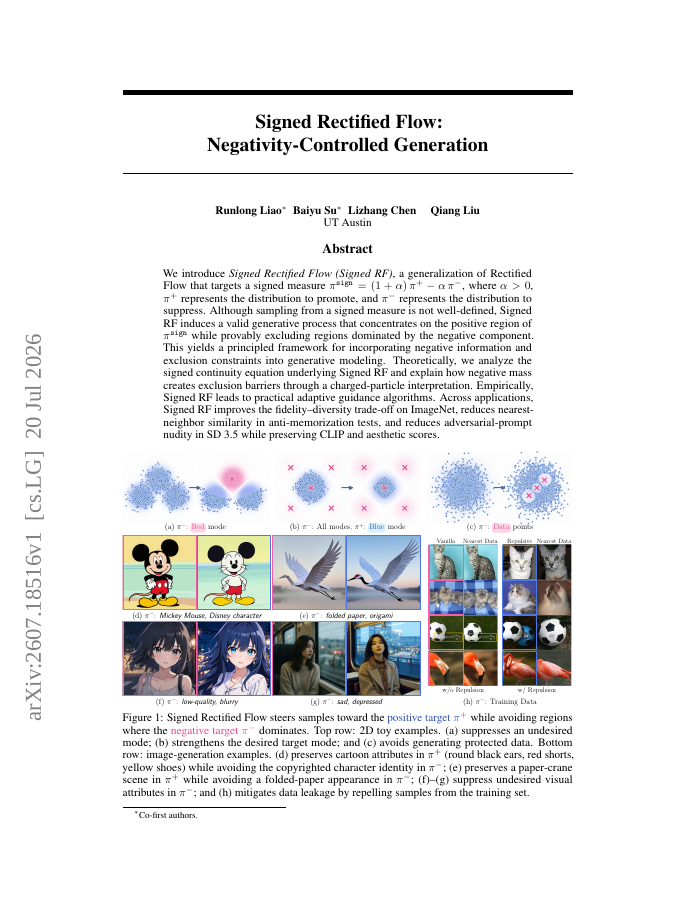
We introduce Signed Rectified Flow (Signed RF), a generalization of Rectified Flow that targets the signed measure π^{sign} = (1+α)π^+ - απ^-, where α>0, π^+ is the distribution to promote, and π^- is the distribution to suppress. Although direct sampling from a signed measure is not well-defined, Signed RF induces a valid generative process that concentrates probability in regions where the signed measure is positive while provably excluding regions dominated by its negative component. It therefore provides a principled framework for incorporating negative information and exclusion constraints into generative modeling. We analyze the signed continuity equation underlying Signed RF and use a charged-particle interpretation to explain how negative mass forms exclusion barriers. This theory further motivates practical adaptive guidance algorithms. Across several applications, Signed RF improves the fidelity-diversity trade-off on ImageNet, reduces nearest-neighbor similarity in anti-memorization experiments, and reduces nudity induced by adversarial prompts in Stable Diffusion 3.5 while preserving CLIP and aesthetic scores.
Signed Rectified Flow: Negativity-Controlled Generation
We introduce Signed Rectified Flow (Signed RF), a generalization of Rectified Flow that targets the signed measure $π^{sign} = (1+α)π^+ - απ^-$, where $α>0$, $π^+$ is the distribution to promote, and $π^-$ is the distribution to suppress.
- Preview
- Year
- 2026
- Hosting
- Full text hostedCC-BY-4.0
Cite
Notes
Only stored in your browser.
Attribution
- Abstract & full text
- arxiv.org/abs/2607.18516CC-BY-4.0
- TL;DR
- Semantic Scholar