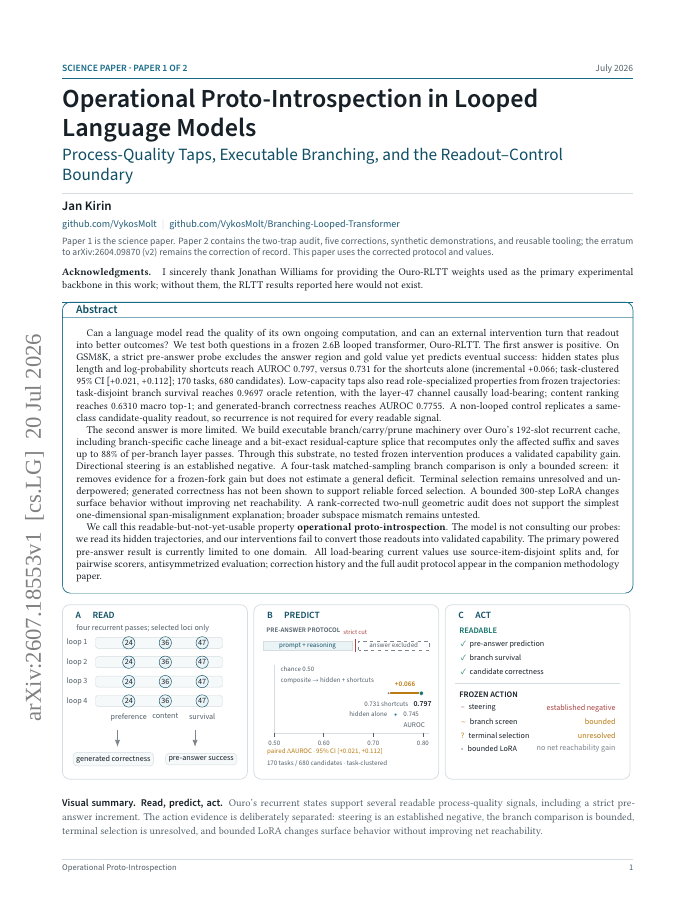
Can a language model read the quality of ongoing computation, and can an external intervention turn that readout into better outcomes? We test both questions in a frozen 2.6B looped transformer, Ouro-RLTT. On GSM8K, a strict pre-answer probe excludes the answer region and gold value yet predicts eventual success: hidden states plus length and log-probability shortcuts reach AUROC 0.797, versus 0.731 for the shortcuts alone (incremental +0.066; task-clustered 95% CI [+0.021, +0.112]; 170 tasks, 680 candidates). Low-capacity taps also read role-specialized properties: task-disjoint branch survival reaches 0.9697 oracle retention, content ranking reaches 0.6310 macro top-1, and generated-branch correctness reaches AUROC 0.7755. A non-looped control replicates a candidate-quality readout, so recurrence is not required for every signal. We build branch/carry/prune machinery over Ouro's 192-slot recurrent cache, including branch-specific cache lineage and a bit-exact residual-capture splice that recomputes only the affected suffix and saves up to 88% of per-branch layer passes. No frozen intervention produces a validated capability gain. Directional steering is an established negative; a four-task matched-sampling comparison removes evidence for a frozen-fork gain but cannot estimate a general deficit; terminal selection remains unresolved and underpowered; and bounded LoRA changes surface behavior without improving net reachability. A two-null audit does not support the simplest span-misalignment explanation. We call this readable-but-not-yet-usable property operational proto-introspection. The model is not consulting our probes: we read its hidden trajectories, and our interventions fail to convert those readouts into validated capability. The pre-answer result is limited to one domain. Load-bearing values use source-item-disjoint splits and antisymmetrized evaluation where applicable.
Operational Proto-Introspection in Looped Language Models: Process-Quality Taps, Executable Branching, and the Readout-Control Boundary
Can a language model read the quality of ongoing computation, and can an external intervention turn that readout into better outcomes? We test both questions in a frozen 2.6B looped transformer, Ouro-RLTT.
- Preview
- Year
- 2026
- Hosting
- Full text hostedCC-BY-4.0
Cite
Notes
Only stored in your browser.
Attribution
- Abstract & full text
- arxiv.org/abs/2607.18553CC-BY-4.0
- TL;DR
- Semantic Scholar