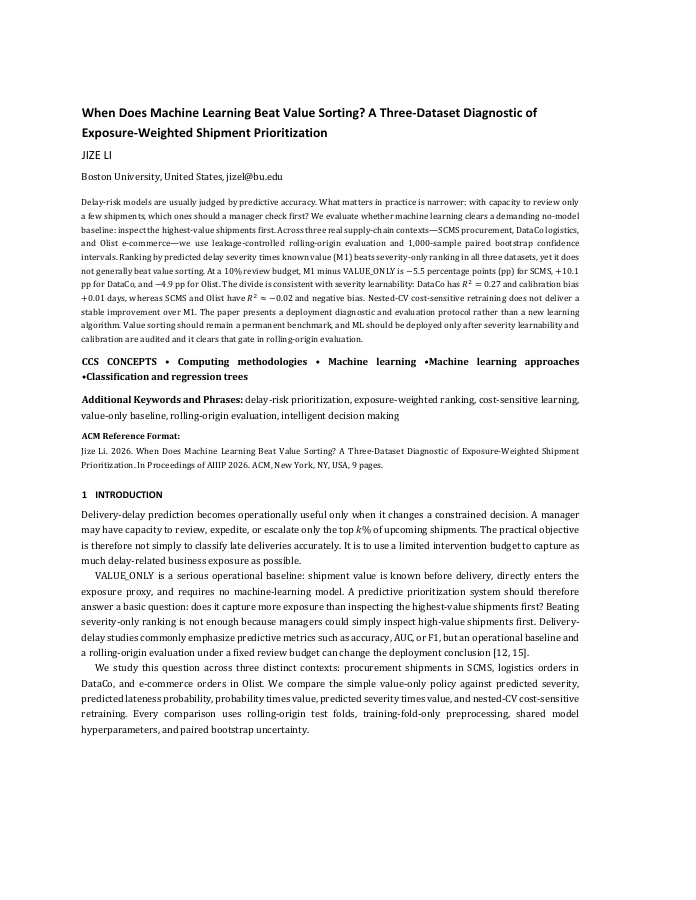
Delay-risk models are usually judged by predictive accuracy. What matters in practice is narrower: with capacity to review only a few shipments, which ones should a manager check first? We evaluate whether machine learning clears a demanding no-model baseline: inspect the highest-value shipments first. Across three real supply-chain contexts: SCMS procurement, DataCo logistics, and Olist e-commerce, we use leakage-controlled rolling-origin evaluation and 1000-sample paired bootstrap confidence intervals. Ranking by predicted delay severity times known value (M1) beats severity-only ranking in all three datasets, yet it does not generally beat value sorting. At a 10% review budget, M1 minus VALUE_ONLY is -5.5 percentage points (pp) for SCMS, +10.1 pp for DataCo, and -4.9 pp for Olist. The divide is consistent with severity learnability: DataCo has R^2 = 0.27 and calibration bias of +0.01 days, whereas SCMS and Olist have R^2 of approximately -0.02 and negative calibration bias. Nested-CV cost-sensitive retraining does not deliver a stable improvement over M1. Rather than proposing a new learning algorithm, this paper presents a deployment diagnostic and evaluation protocol. Value sorting should remain a permanent benchmark, and ML should be deployed only after severity learnability and calibration have been audited and the model clears that gate under leakage-controlled rolling-origin evaluation.
When Does Machine Learning Beat Value Sorting? A Three-Dataset Diagnostic of Exposure-Weighted Shipment Prioritization
Delay-risk models are usually judged by predictive accuracy. What matters in practice is narrower: with capacity to review only a few shipments, which ones should a manager check first? We evaluate whether machine learning clears a demanding no-model baseline: inspect the…
- Preview
- Year
- 2026
- Hosting
- Abstract onlyARXIV-DEFAULT
Cite
Notes
Only stored in your browser.
Attribution
- Abstract & full text
- arxiv.org/abs/2607.18573ARXIV-DEFAULT
- TL;DR
- Semantic Scholar