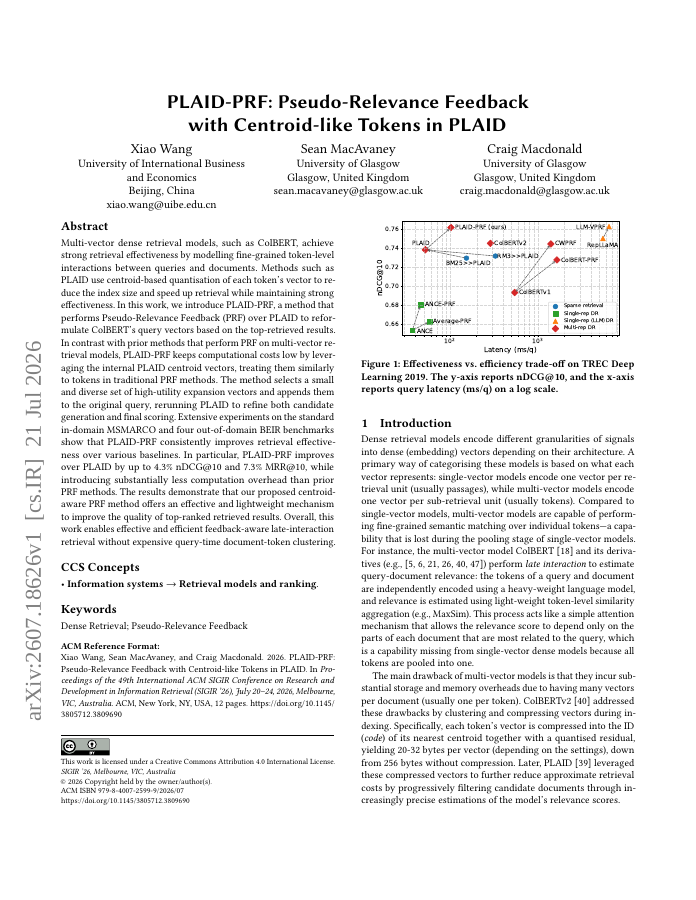
Multi-vector dense retrieval models, such as ColBERT, achieve strong retrieval effectiveness by modelling fine-grained token-level interactions between queries and documents. Methods such as PLAID use centroid-based quantisation of each token's vector to reduce the index size and speed up retrieval while maintaining strong effectiveness. In this work, we introduce PLAID-PRF, a method that performs Pseudo-Relevance Feedback (PRF) over PLAID to reformulate ColBERT's query vectors based on the top-retrieved results. In contrast with prior methods that perform PRF on multi-vector retrieval models, PLAID-PRF keeps computational costs low by leveraging the internal PLAID centroid vectors, treating them similarly to tokens in traditional PRF methods. The method selects a small and diverse set of high-utility expansion vectors and appends them to the original query, rerunning PLAID to refine both candidate generation and final scoring. Extensive experiments on the standard in-domain MSMARCO and four out-of-domain BEIR benchmarks show that PLAID-PRF consistently improves retrieval effectiveness over various baselines. In particular, PLAID-PRF improves over PLAID by up to 4.3% nDCG@10 and 7.3% MRR@10, while introducing substantially less computation overhead than prior PRF methods. The results demonstrate that our proposed centroid-aware PRF method offers an effective and lightweight mechanism to improve the quality of top-ranked retrieved results. Overall, this work enables effective and efficient feedback-aware late-interaction retrieval without expensive query-time document-token clustering.
PLAID-PRF: Pseudo-Relevance Feedback with Centroid-like Tokens in PLAID
Multi-vector dense retrieval models, such as ColBERT, achieve strong retrieval effectiveness by modelling fine-grained token-level interactions between queries and documents.
- Preview
- Year
- 2026
- Hosting
- Abstract onlyARXIV-DEFAULT
Cite
Notes
Only stored in your browser.
Attribution
- Abstract & full text
- arxiv.org/abs/2607.18626ARXIV-DEFAULT
- TL;DR
- Semantic Scholar