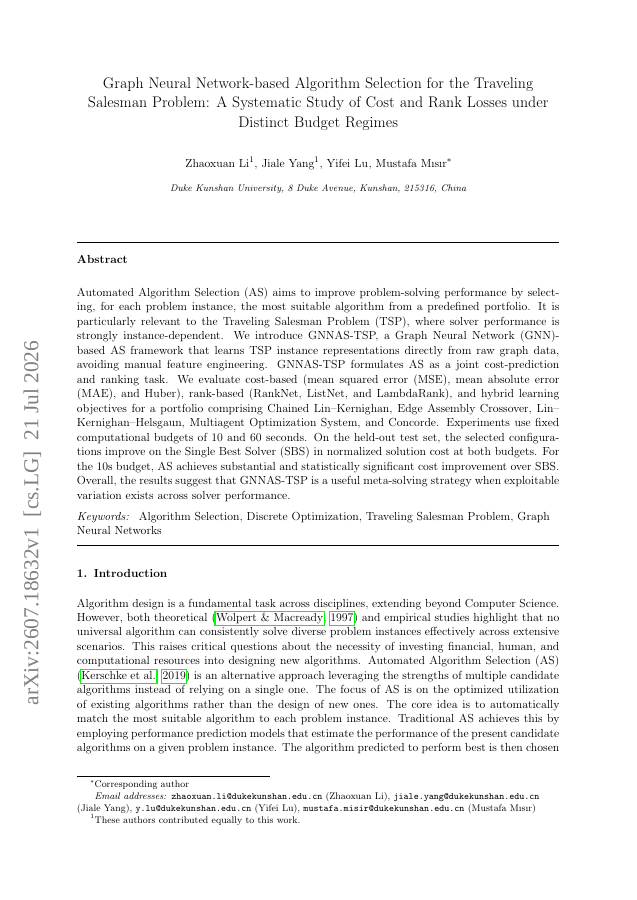
Automated Algorithm Selection (AS) aims to improve problem-solving performance by selecting, for each problem instance, the most suitable algorithm from a predefined portfolio. This is particularly relevant to the Traveling Salesman Problem (TSP), where solver performance is strongly instance-dependent. We introduce GNNAS-TSP, a Graph Neural Network (GNN)-based AS framework that learns TSP instance representations directly from raw graph data, avoiding manual feature engineering. GNNAS-TSP formulates AS as a joint cost-prediction and ranking task. We evaluate cost-based (mean squared error (MSE), mean absolute error (MAE), and Huber), rank-based (RankNet, ListNet, and LambdaRank), and hybrid learning objectives for a portfolio comprising Chained Lin-Kernighan, Edge Assembly Crossover, Lin-Kernighan-Helsgaun, Multiagent Optimization System, and Concorde. Experiments use fixed computational budgets of 10 and 60 seconds. On the held-out test set, the selected configurations improve on the Single Best Solver (SBS) in normalized solution cost at both budgets. For the 10s budget, AS achieves substantial and statistically significant cost improvement over SBS. Overall, the results suggest that GNNAS-TSP is a useful meta-solving strategy when exploitable variation exists across solver performance.
Graph Neural Network-based Algorithm Selection for the Traveling Salesman Problem: A Systematic Study of Cost and Rank Losses under Distinct Budget Regimes
Automated Algorithm Selection (AS) aims to improve problem-solving performance by selecting, for each problem instance, the most suitable algorithm from a predefined portfolio.
- Preview
- Year
- 2026
- Hosting
- Abstract onlyARXIV-DEFAULT
Cite
Notes
Only stored in your browser.
Attribution
- Abstract & full text
- arxiv.org/abs/2607.18632ARXIV-DEFAULT
- TL;DR
- Semantic Scholar