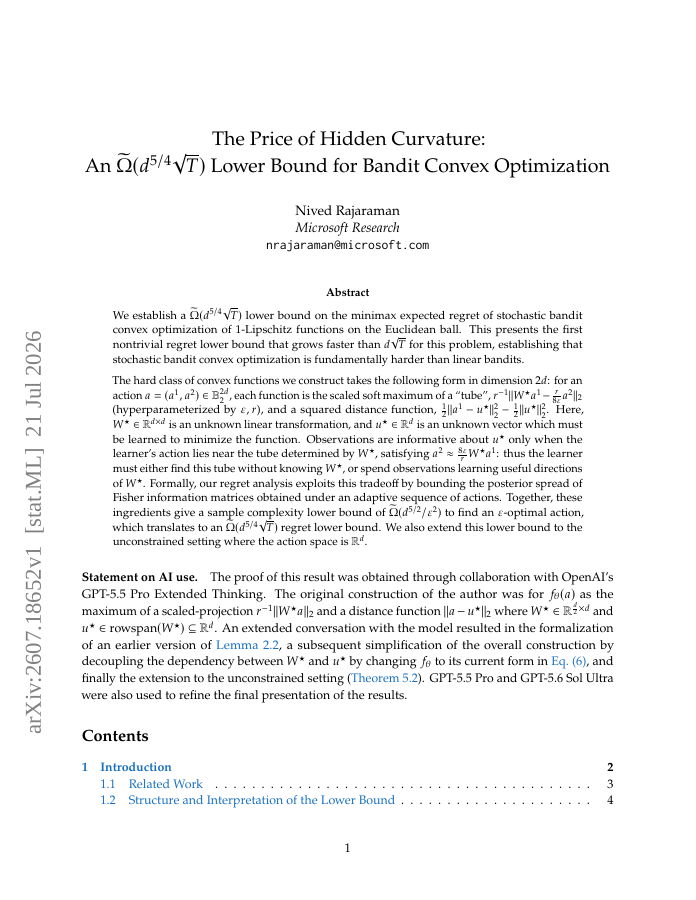
We establish a \widetildeΩ(d^{5/4}\sqrt T) lower bound on the minimax expected regret of stochastic bandit convex optimization of 1-Lipschitz functions on the Euclidean ball. This presents the first nontrivial regret lower bound that grows faster than d\sqrt{T} for this problem, establishing that stochastic bandit convex optimization is fundamentally harder than linear bandits. The hard class of convex functions we construct takes the following form in dimension 2d: for an action a = (a^1,a^2) \in \mathbb{B}^{2d}_2, each function is the scaled soft maximum of a "tube", r^{-1} | W^\star a^1 - \frac{r}{8\varepsilon} a^2 |_2 (hyperparameterized by \varepsilon,r), and a squared distance function, \frac12 | a^1 - u^\star |_2^2 - \frac12 | u^\star |_2^2. Here, W^\star \in \mathbb{R}^{d \times d} is an unknown linear transformation, and u^\star \in \mathbb{R}^{d} is an unknown vector which must be learned to minimize the function. Observations are informative about u^\star only when the learner's action lies near the tube determined by W^\star, satisfying a^2 \approx \frac{8\varepsilon}{r} W^\star a^1: thus the learner must either find this tube without knowing W^\star, or spend observations learning useful directions of W^\star. Formally, our regret analysis exploits this tradeoff by bounding the posterior spread of Fisher information matrices obtained under an adaptive sequence of actions. Together, these ingredients give a sample complexity lower bound of \widetildeΩ(d^{5/2}/\varepsilon^2) to find an \varepsilon-optimal action, which translates to an \widetildeΩ (d^{5/4} \sqrt{T}) regret lower bound. We also extend this lower bound to the unconstrained setting where the action space is \mathbb{R}^d.
The Price of Hidden Curvature: An $\widetildeΩ (d^{5/4} \sqrt{T})$ Lower Bound for Bandit Convex Optimization
We establish a $\widetildeΩ(d^{5/4}\sqrt T)$ lower bound on the minimax expected regret of stochastic bandit convex optimization of $1$-Lipschitz functions on the Euclidean ball.
- Preview
- Year
- 2026
- Hosting
- Full text hostedCC-BY-4.0
Cite
Notes
Only stored in your browser.
Attribution
- Abstract & full text
- arxiv.org/abs/2607.18652CC-BY-4.0
- TL;DR
- Semantic Scholar