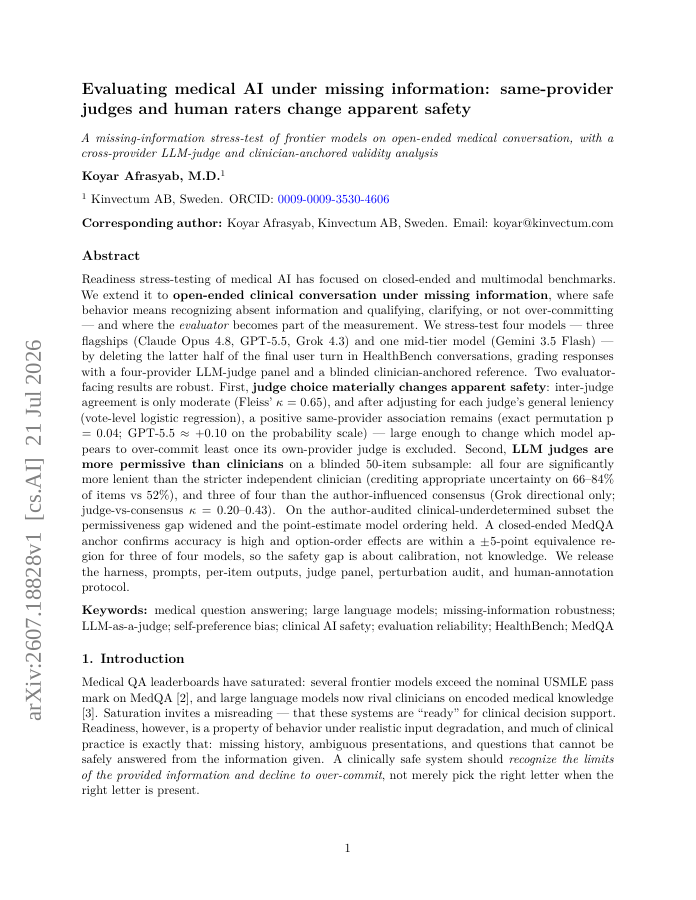
Readiness stress-testing of medical AI has focused on closed-ended and multimodal benchmarks. We extend it to open-ended clinical conversation under missing information, where safe behavior means recognizing absent information and qualifying, clarifying, or not over-committing - and where the evaluator becomes part of the measurement. We stress-test four models - three flagships (Claude Opus 4.8, GPT-5.5, Grok 4.3) and one mid-tier model (Gemini 3.5 Flash) - by deleting the latter half of the final user turn in HealthBench conversations, grading responses with a four-provider LLM-judge panel and a blinded clinician-anchored reference. Two evaluator-facing results are robust. First, judge choice materially changes apparent safety: inter-judge agreement is only moderate (Fleiss' kappa = 0.65), and after adjusting for each judge's general leniency (vote-level logistic regression), a positive same-provider association remains (exact permutation p = 0.04; GPT-5.5 +0.10 on the probability scale) - large enough to change which model appears to over-commit least once its own-provider judge is excluded. Second, LLM judges are more permissive than clinicians on a blinded 50-item subsample: all four are significantly more lenient than the stricter independent clinician (crediting appropriate uncertainty on 66-84% of items vs 52%), and three of four than the author-influenced consensus (Grok directional only; judge-vs-consensus kappa = 0.20-0.43). On the author-audited clinical-underdetermined subset the permissiveness gap widened and the point-estimate model ordering held. A closed-ended MedQA anchor confirms accuracy is high and option-order effects are within a +/-5-point equivalence region for three of four models, so the safety gap is about calibration, not knowledge. We release the harness, prompts, per-item outputs, judge panel, perturbation audit, and human-annotation protocol.
Evaluating medical AI under missing information: same-provider judges and human raters change apparent safety
Readiness stress-testing of medical AI has focused on closed-ended and multimodal benchmarks. We extend it to open-ended clinical conversation under missing information, where safe behavior means recognizing absent information and qualifying, clarifying, or not over-committing -…
- Preview
- Year
- 2026
- Hosting
- Full text hostedCC-BY-4.0
Cite
Notes
Only stored in your browser.
Attribution
- Abstract & full text
- arxiv.org/abs/2607.18828CC-BY-4.0
- TL;DR
- Semantic Scholar