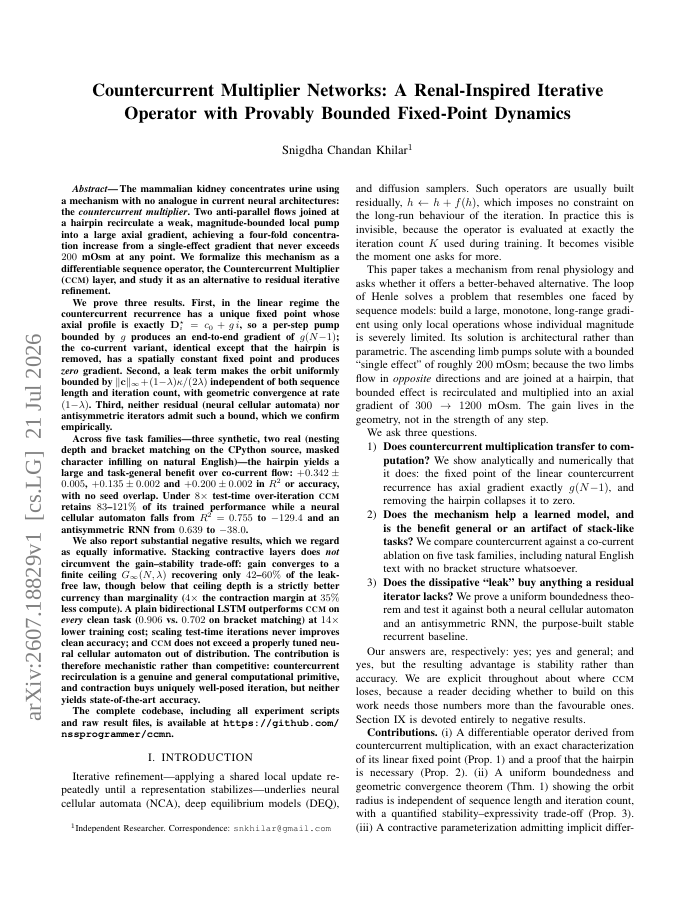
The mammalian kidney concentrates urine using a mechanism with no analogue in current neural architectures: the countercurrent multiplier. Two anti-parallel flows joined at a hairpin recirculate a weak magnitude-bounded local pump into a large axial gradient achieving a four-fold concentration increase from a single-effect gradient that never exceeds 200 mOsm at any point. We formalize this mechanism as a differentiable sequence operator the Countercurrent Multiplier (CCM) layer and study it as an alternative to residual iterative refinement.
Countercurrent Multiplier Networks: A Renal-Inspired Iterative Operator with Provably Bounded Fixed-Point Dynamics
The mammalian kidney concentrates urine using a mechanism with no analogue in current neural architectures: the countercurrent multiplier. Two anti-parallel flows joined at a hairpin recirculate a weak magnitude-bounded local pump into a large axial gradient achieving a…
- Preview
- Year
- 2026
- Hosting
- Abstract onlyARXIV-DEFAULT
Cite
Notes
Only stored in your browser.
Attribution
- Abstract & full text
- arxiv.org/abs/2607.18829ARXIV-DEFAULT
- TL;DR
- Semantic Scholar