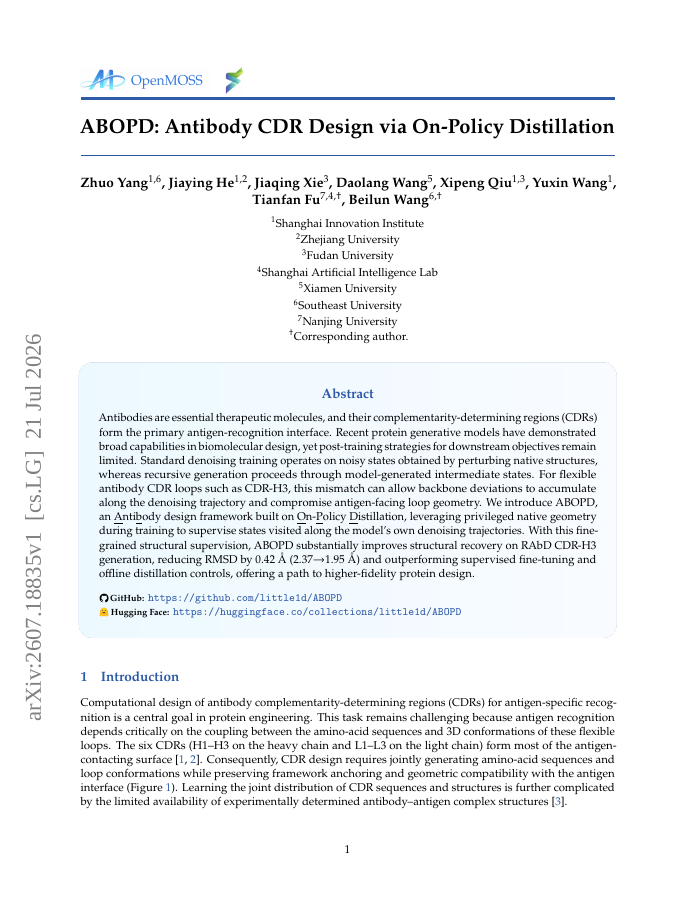
Antibodies are essential therapeutic molecules, and their complementarity-determining regions (CDRs) form the primary antigen-recognition interface. Recent protein generative models have demonstrated broad capabilities in biomolecular design, yet post-training strategies for downstream objectives remain limited. Standard denoising training operates on noisy states obtained by perturbing native structures, whereas recursive generation proceeds through model-generated intermediate states. For flexible antibody CDR loops such as CDR-H3, this mismatch can allow backbone deviations to accumulate along the denoising trajectory and compromise antigen-facing loop geometry. We introduce ABOPD, an antibody design framework based on on-policy distillation that leverages privileged native geometry during training to supervise states visited along the model's own denoising trajectories. With this fine-grained structural supervision, ABOPD substantially improves structural recovery on RAbD CDR-H3 generation, reducing RMSD by 0.42 Å (from 2.37 Å to 1.95 Å) and outperforming supervised fine-tuning and offline distillation controls, offering a path to higher-fidelity protein design.
ABOPD: Antibody CDR Design via On-Policy Distillation
Antibodies are essential therapeutic molecules, and their complementarity-determining regions (CDRs) form the primary antigen-recognition interface. Recent protein generative models have demonstrated broad capabilities in biomolecular design, yet post-training strategies for…
- Preview
- Year
- 2026
- Hosting
- Full text hostedCC-BY-4.0
Cite
Notes
Only stored in your browser.
Attribution
- Abstract & full text
- arxiv.org/abs/2607.18835CC-BY-4.0
- TL;DR
- Semantic Scholar