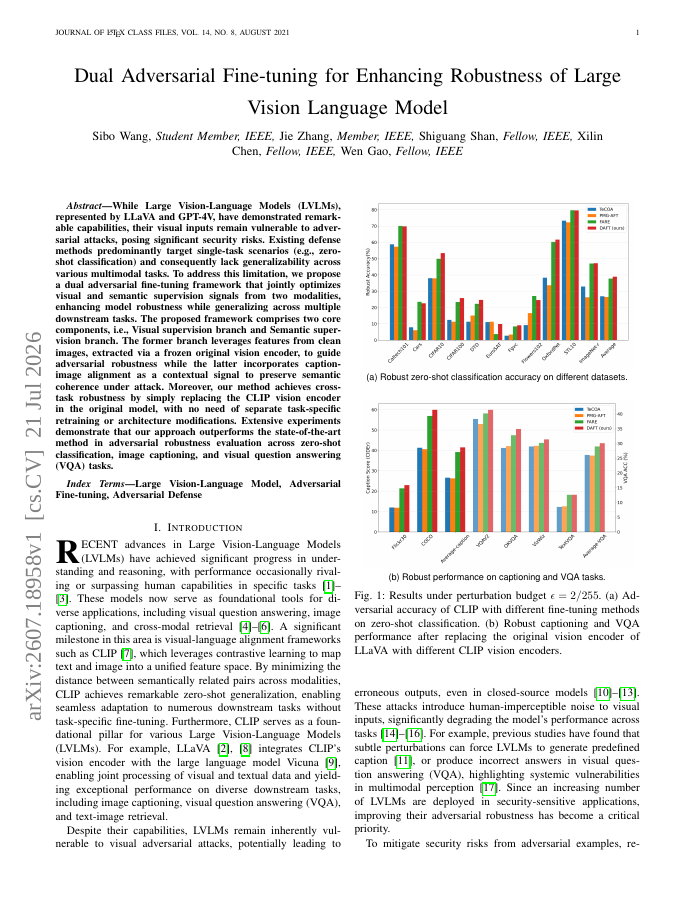
While Large Vision-Language Models (LVLMs), represented by LLaVA and GPT-4V, have demonstrated remarkable capabilities, their visual inputs remain vulnerable to adversarial attacks, posing significant security risks. Existing defense methods predominantly target single-task scenarios (e.g., zero-shot classification) and consequently lack generalizability across various multimodal tasks. To address this limitation, we propose a dual adversarial fine-tuning framework that jointly optimizes visual and semantic supervision signals from two modalities, enhancing model robustness while generalizing across multiple downstream tasks. The proposed framework comprises two core components, i.e., Visual supervision branch and Semantic supervision branch. The former branch leverages features from clean images, extracted via a frozen original vision encoder, to guide adversarial robustness while the latter incorporates caption-image alignment as a contextual signal to preserve semantic coherence under attack. Moreover, our method achieves cross-task robustness by simply replacing the CLIP vision encoder in the original model, with no need of separate task-specific retraining or architecture modifications.Extensive experiments demonstrate that our approach outperforms the state-of-the-art method in adversarial robustness evaluation across zero-shot classification, image captioning, and visual question answering (VQA) tasks.
Dual Adversarial Fine-tuning for Enhancing Robustness of Large Vision Language Model
While Large Vision-Language Models (LVLMs), represented by LLaVA and GPT-4V, have demonstrated remarkable capabilities, their visual inputs remain vulnerable to adversarial attacks, posing significant security risks.
- Preview
- Year
- 2026
- Hosting
- Full text hostedCC-BY-4.0
Cite
Notes
Only stored in your browser.
Attribution
- Abstract & full text
- arxiv.org/abs/2607.18958CC-BY-4.0
- TL;DR
- Semantic Scholar