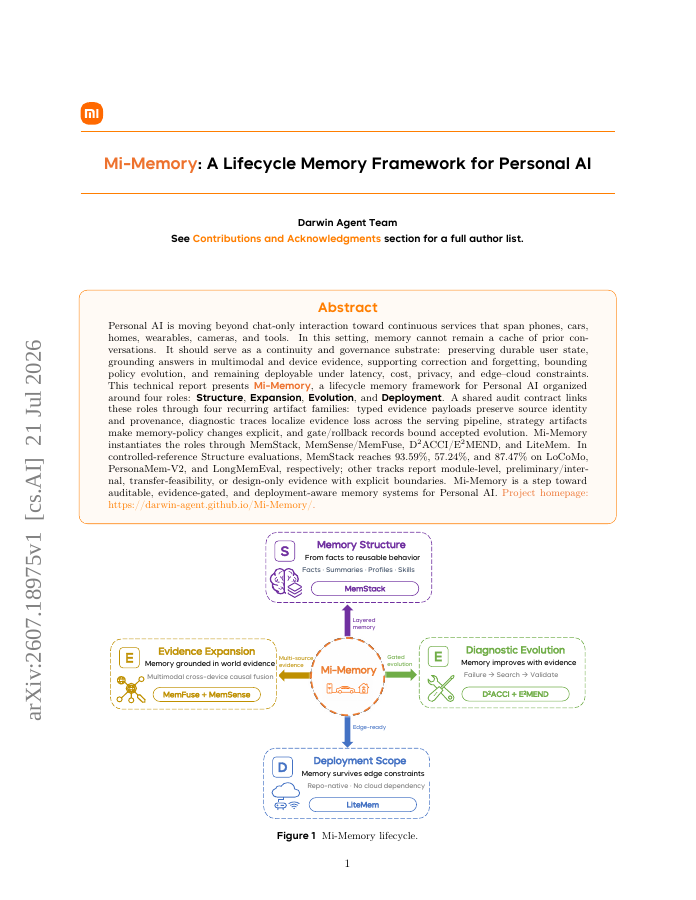
Personal AI is moving beyond chat-only interaction toward continuous services that span phones, cars, homes, wearables, cameras, and tools. In this setting, memory cannot remain a cache of prior conversations. It should serve as a continuity and governance substrate: preserving durable user state, grounding answers in multimodal and device evidence, supporting correction and forgetting, bounding policy evolution, and remaining deployable under latency, cost, privacy, and edge-cloud constraints. This technical report presents Mi-Memory, a lifecycle memory framework for Personal AI organized around four roles: Structure, Expansion, Evolution, and Deployment. A shared audit contract links these roles through four recurring artifact families: typed evidence payloads preserve source identity and provenance, diagnostic traces localize evidence loss across the serving pipeline, strategy artifacts make memory-policy changes explicit, and gate/rollback records bound accepted evolution. MiMemory instantiates the roles through MemStack, MemSense/MemFuse, D^{2}ACCI/E^{2}MEND, and LiteMem. In controlled-reference Structure evaluations, MemStack reaches 93.59%, 57.24%, and 87.47% on LoCoMo, PersonaMem-V2, and LongMemEval, respectively; other tracks report module-level, preliminary/internal, transfer-feasibility, or design-only evidence with explicit boundaries. MiMemory is a step toward auditable, evidence-gated, and deployment-aware memory systems for Personal AI. Project homepage: https://darwin-agent.github.io/Mi-Memory/ .
Mi-Memory: A Lifecycle Memory Framework for Personal AI
Personal AI is moving beyond chat-only interaction toward continuous services that span phones, cars, homes, wearables, cameras, and tools. In this setting, memory cannot remain a cache of prior conversations.
- Preview
- Year
- 2026
- Hosting
- Full text hostedCC-BY-4.0
Cite
Notes
Only stored in your browser.
Attribution
- Abstract & full text
- arxiv.org/abs/2607.18975CC-BY-4.0
- TL;DR
- Semantic Scholar