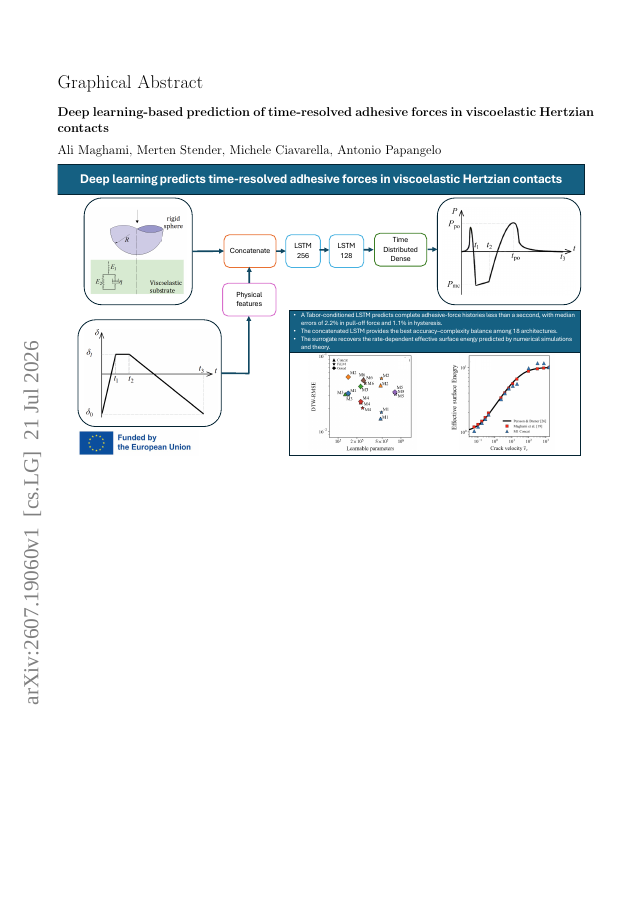
Fast prediction of the response of adhesive soft viscoelastic contacts represents a current challenge in soft robotics and for gripping and manipulation tasks. Determining the complete time-resolved force trajectory requires full numerical simulations, whose computational cost is strongly parameter-dependent, making them impractical for real-time application or design-optimization loops. In this work, we overcome this limitation by training a scalar-conditioned, stateful, sequence-to-sequence deep learning model to predict the full force evolution from a prescribed displacement history for both short- and long-range adhesion regimes. The data set spans four orders of magnitude in loading and unloading rates and includes varied dwell times, with the Tabor parameter ranging from 0.2 to 3.2. To enable learning across these heterogeneous time scales, we introduce a fixed-measurement-step (FMS) representation that converts variable-length trajectories into fixed-length sequences while preserving their physical-time information. Different architectures were trained, including long short-term memory (LSTM) networks, temporal convolutional neural (TCN) networks, and time-distributed dense layers with three different Tabor-conditioning mechanisms. The models were compared using global waveform and error metrics. We found that the best-performing model has an LSTM architecture with concatenated conditioning, which achieves a held-out mean-squared error of 5.0\times10^{-4}, a median pull-off-force error of \approx2.2%, and a median hysteresis error of \approx1.1%. For the held-out protocols, the model predicts a complete force trajectory with a median inference time of 0.16 s. The model is tested across unseen parameter combinations and against analytical limiting cases, providing a rapid surrogate for repeated numerical evaluations with potential use in control-oriented applications.
Deep learning-based prediction of time-resolved adhesive forces in viscoelastic Hertzian contacts
Fast prediction of the response of adhesive soft viscoelastic contacts represents a current challenge in soft robotics and for gripping and manipulation tasks. Determining the complete time-resolved force trajectory requires full numerical simulations, whose computational cost…
- Preview
- Year
- 2026
- Hosting
- Full text hostedCC-BY-4.0
Cite
Notes
Only stored in your browser.
Attribution
- Abstract & full text
- arxiv.org/abs/2607.19060CC-BY-4.0
- TL;DR
- Semantic Scholar