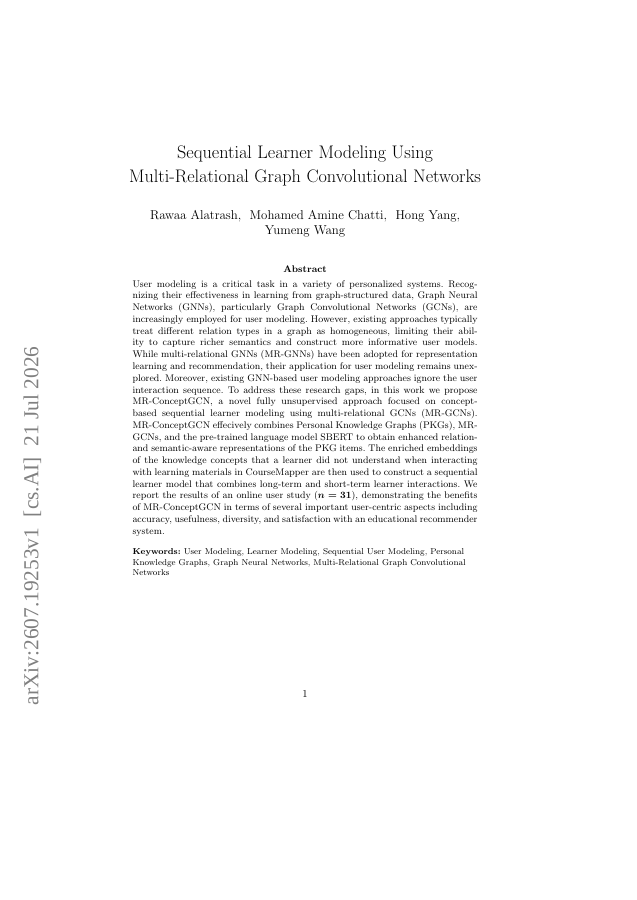
User modeling is a critical task in a variety of personalized systems. Recognizing their effectiveness in learning from graph-structured data, Graph Neural Networks (GNNs), particularly Graph Convolutional Networks (GCNs), are increasingly employed for user modeling. However, existing approaches typically treat different relation types in a graph as homogeneous, limiting their ability to capture richer semantics and construct more informative user models. While multi-relational GNNs (MR-GNNs) have been adopted for representation learning and recommendation, their application for user modeling remains unexplored. Moreover, existing GNN-based user modeling approaches ignore the user interaction sequence. To address these research gaps, in this work we propose MR-ConceptGCN, a novel fully unsupervised approach focused on concept-based sequential learner modeling using multi-relational GCNs (MR-GCNs). MR-ConceptGCN effecively combines Personal Knowledge Graphs (PKGs), MR-GCNs, and the pre-trained language model SBERT to obtain enhanced relation- and semantic-aware representations of the PKG items. The enriched embeddings of the knowledge concepts that a learner did not understand when interacting with learning materials in CourseMapper are then used to construct a sequential learner model that combines long-term and short-term learner interactions. We report the results of an online user study (n = 31), demonstrating the benefits of MR-ConceptGCN in terms of several important user-centric aspects including accuracy, usefulness, diversity, and satisfaction with an educational recommender system.
Sequential Learner Modeling Using Multi-Relational Graph Convolutional Networks
User modeling is a critical task in a variety of personalized systems. Recognizing their effectiveness in learning from graph-structured data, Graph Neural Networks (GNNs), particularly Graph Convolutional Networks (GCNs), are increasingly employed for user modeling.
- Preview
- Year
- 2026
- Hosting
- Excerpt onlyCC-BY-NC-SA-4.0
Cite
Notes
Only stored in your browser.
Attribution
- Abstract & full text
- arxiv.org/abs/2607.19253CC-BY-NC-SA-4.0
- TL;DR
- Semantic Scholar