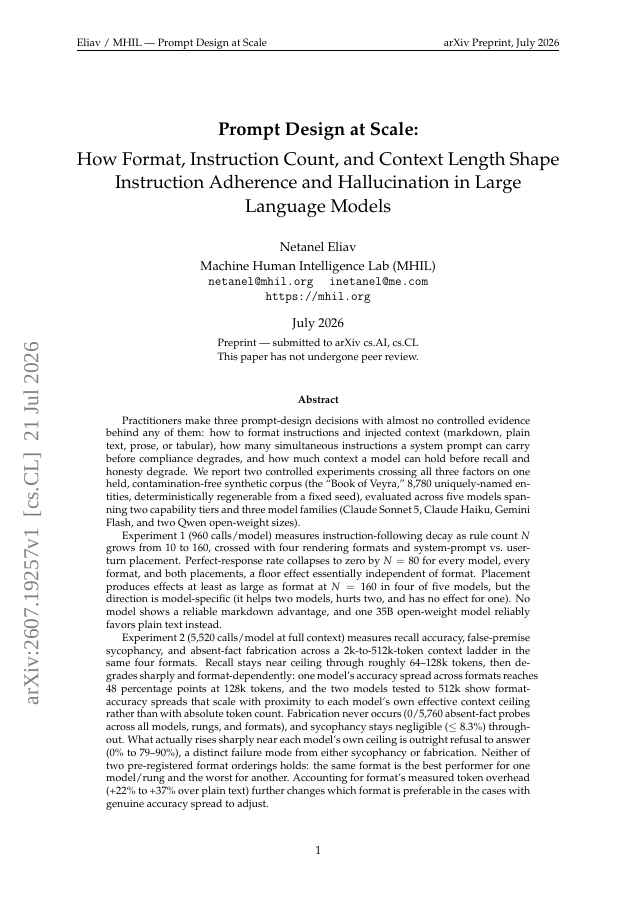
Practitioners make three prompt-design decisions with almost no controlled evidence behind them: how to format instructions and context (markdown, plain text, prose, or tabular), how many simultaneous instructions a system prompt can carry before compliance degrades, and how much context a model can hold before recall and honesty degrade. We report two controlled experiments crossing all three factors on one held, contamination-free synthetic corpus (the "Book of Veyra," 8,780 uniquely-named entities, deterministically regenerable from a fixed seed), evaluated across five models. Experiment 1 (960 calls/model) measures instruction-following decay as rule count N grows from 10 to 160, crossed with four formats and system-prompt vs. user-turn placement. Perfect-response rate collapses to zero by N=80 for every model, format, and placement. Placement produces effects at least as large as format at N=160 in most models, but the direction is model-specific. No model shows a reliable markdown advantage; one 35B model favors plain text instead. Experiment 2 (5,520 calls/model) measures recall accuracy, false-premise sycophancy, and absent-fact fabrication across a 2k-to-512k-token context ladder in the same four formats. Recall stays near ceiling through 64-128k tokens, then degrades sharply and format-dependently: one model's accuracy spread reaches 48 points at 128k tokens. Fabrication never occurs (0/5,760 probes), and sycophancy stays negligible (<=8.3%). What rises sharply near each model's context ceiling is outright refusal to answer (0% to 79-90%), distinct from sycophancy or fabrication. Neither pre-registered format ordering holds, and token overhead (+22% to +37% over plain text) further changes which format is preferable where accuracy spread is genuine. We release the full harness, corpus generator, and raw results (VeyraBench): https://github.com/iNetanel/veyrabench
Prompt Design at Scale: How Format, Instruction Count, and Context Length Shape Instruction Adherence and Hallucination in Large Language Models
Practitioners make three prompt-design decisions with almost no controlled evidence behind them: how to format instructions and context (markdown, plain text, prose, or tabular), how many simultaneous instructions a system prompt can carry before compliance degrades, and how…
- Preview
- Year
- 2026
- Hosting
- Full text hostedCC-BY-4.0
Cite
Notes
Only stored in your browser.
Attribution
- Abstract & full text
- arxiv.org/abs/2607.19257CC-BY-4.0
- TL;DR
- Semantic Scholar