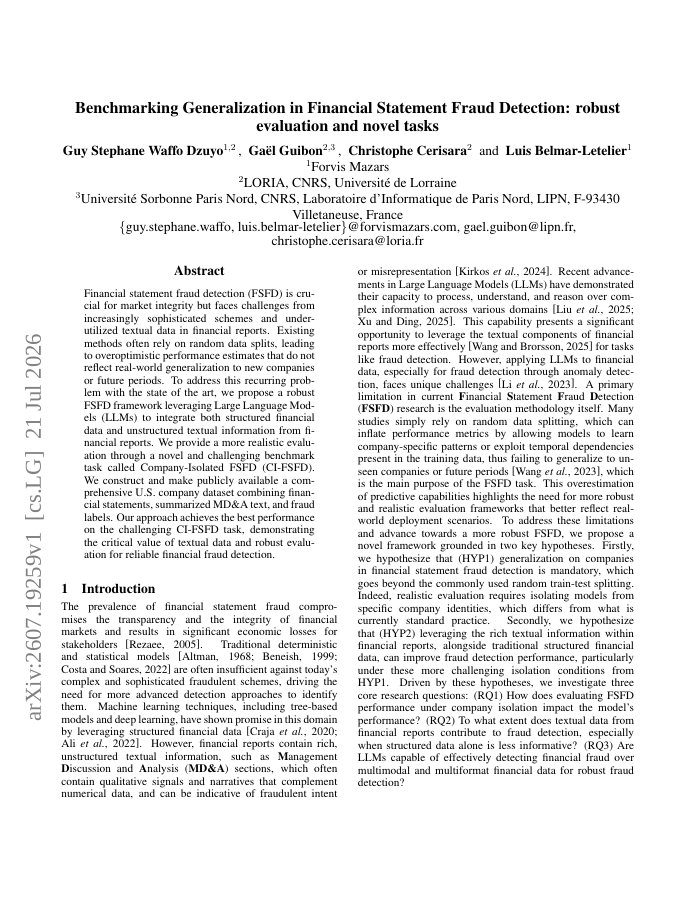
Financial statement fraud detection (FSFD) is crucial for market integrity but faces challenges from increasingly sophisticated schemes and under-utilized textual data in financial reports. Existing methods often rely on random data splits, leading to overoptimistic performance estimates that do not reflect real-world generalization to new companies or future periods. To address this recurring problem with the state of the art, we propose a robust FSFD framework leveraging Large Language Models (LLMs) to integrate both structured financial data and unstructured textual information from financial reports. We provide a more realistic evaluation through a novel and challenging benchmark task called Company-Isolated FSFD (CI-FSFD). We construct and make publicly available a comprehensive U.S. company dataset combining financial statements, summarized MD&A text, and fraud labels. Our approach achieves the best performance on the challenging CI-FSFD task, demonstrating the critical value of textual data and robust evaluation for reliable financial fraud detection.
Benchmarking Generalization in Financial Statement Fraud Detection: robust evaluation and novel tasks
Financial statement fraud detection (FSFD) is crucial for market integrity but faces challenges from increasingly sophisticated schemes and under-utilized textual data in financial reports.
- Preview
- Year
- 2026
- Hosting
- Excerpt onlyCC-BY-NC-4.0
Cite
Notes
Only stored in your browser.
Attribution
- Abstract & full text
- arxiv.org/abs/2607.19259CC-BY-NC-4.0
- TL;DR
- Semantic Scholar