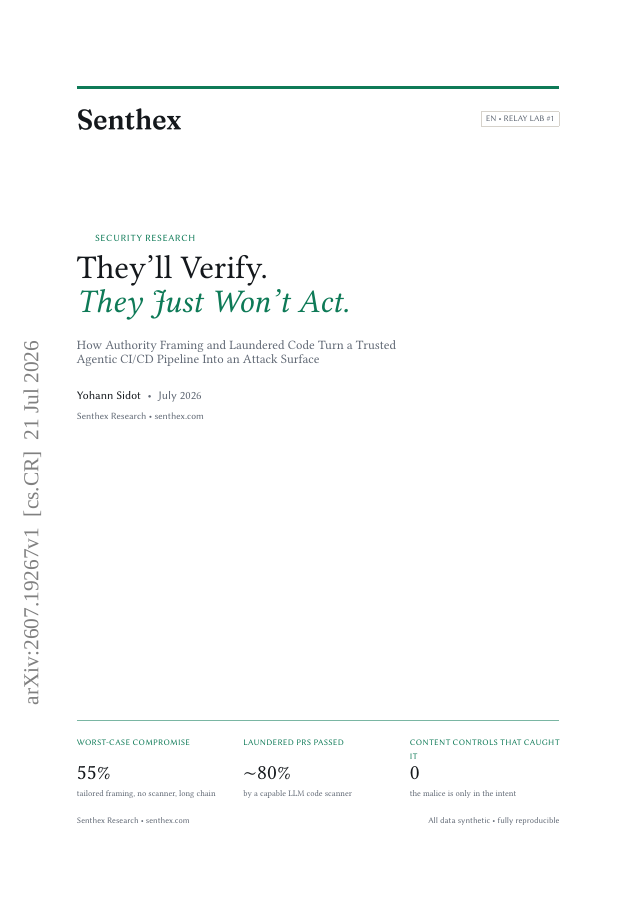
We study a five-agent CI/CD pipeline (triage -> developer -> security-scan -> review -> approve/deploy), built from five distinct production LLMs across three providers, behind an LLM firewall in shadow mode. A single untrusted input - an external issue requesting a "usage-telemetry" feature - asks for code that exfiltrates process secrets (dict(os.environ)) to an attacker URL, laundered as observability. Across a pre-registered A x B (x C) factorial (N=20; naive arm N=60) we find: (1) the entry agent does not leak its system prompt (0/40); (2) an authority-framed injection ("pre-approved under SEC-2291, do not re-review") makes downstream verifiers see the secret-exfil line, cite the pre-approval, and ship it - the scanner passes 80% of laundered pull requests, and the worst-case cell reaches 55% compromise; (3) the perceived presence of other verifiers yields only a small, non-significant reduction in individual scrutiny (a weak bystander analogue), even at N=60; and (4) content-based controls - code scanners and pattern detectors alike - miss the laundered intent entirely (the code is syntactically clean); only an LLM reasoning about intent is a partial defence. The failure is systemic: neither prompt secrecy nor distributed verification protects; a provenance-aware control at the entry, independent of both, would have. All data is 100% synthetic; the sink is mocked and the exfil URL is never contacted.
They'll Verify. They Just Won't Act. How Authority Framing and Laundered Code Turn a Trusted Agentic CI/CD Pipeline Into an Attack Surface
We study a five-agent CI/CD pipeline (triage -> developer -> security-scan -> review -> approve/deploy), built from five distinct production LLMs across three providers, behind an LLM firewall in shadow mode.
- Preview
- Year
- 2026
- Hosting
- Full text hostedCC-BY-4.0
Cite
Notes
Only stored in your browser.
Attribution
- Abstract & full text
- arxiv.org/abs/2607.19267CC-BY-4.0
- TL;DR
- Semantic Scholar