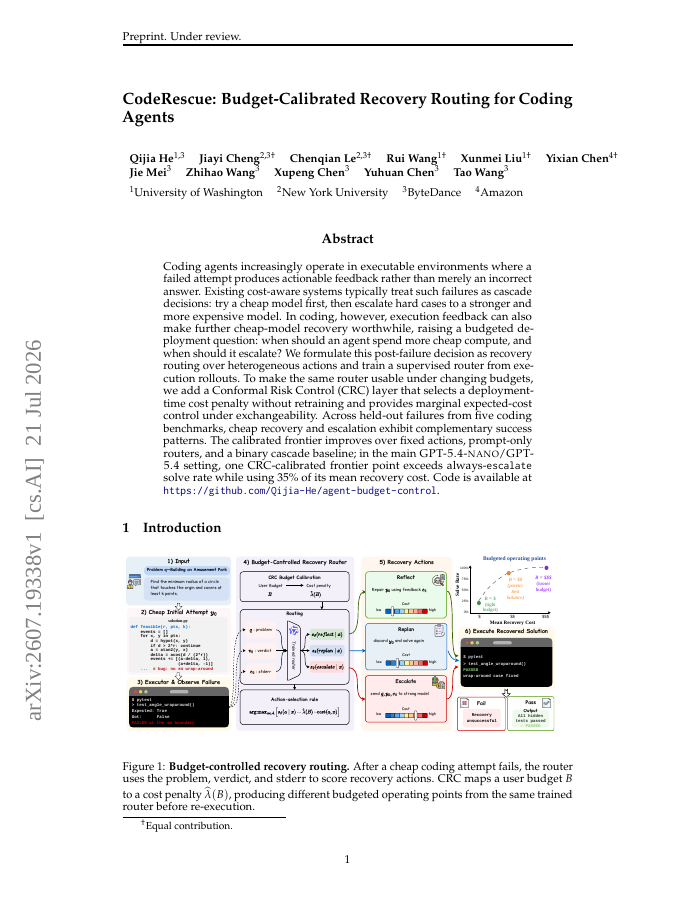
Coding agents increasingly operate in executable environments where a failed attempt produces actionable feedback rather than merely an incorrect answer. Existing cost-aware systems typically treat such failures as cascade decisions: try a cheap model first, then escalate hard cases to a stronger and more expensive model. In coding, however, execution feedback can also make further cheap-model recovery worthwhile, raising a budgeted deployment question: when should an agent spend more cheap compute, and when should it escalate? We formulate this post-failure decision as recovery routing over heterogeneous actions and train a supervised router from execution rollouts. To make the same router usable under changing budgets, we add a Conformal Risk Control (CRC) layer that selects a deployment-time cost penalty without retraining and provides marginal expected-cost control under exchangeability. Across held-out failures from five coding benchmarks, cheap recovery and escalation exhibit complementary success patterns. The calibrated frontier improves over fixed actions, prompt-only routers, and a binary cascade baseline; in the main GPT-5.4-nano/GPT-5.4 setting, one CRC-calibrated frontier point exceeds always-escalate solve rate while using 35% of its mean recovery cost. Code is available at https://github.com/Qijia-He/agent-budget-control.
CodeRescue: Budget-Calibrated Recovery Routing for Coding Agents
Coding agents increasingly operate in executable environments where a failed attempt produces actionable feedback rather than merely an incorrect answer. Existing cost-aware systems typically treat such failures as cascade decisions: try a cheap model first, then escalate hard…
- Preview
- Year
- 2026
- Hosting
- Full text hostedCC-BY-4.0
Cite
Notes
Only stored in your browser.
Attribution
- Abstract & full text
- arxiv.org/abs/2607.19338CC-BY-4.0
- TL;DR
- Semantic Scholar