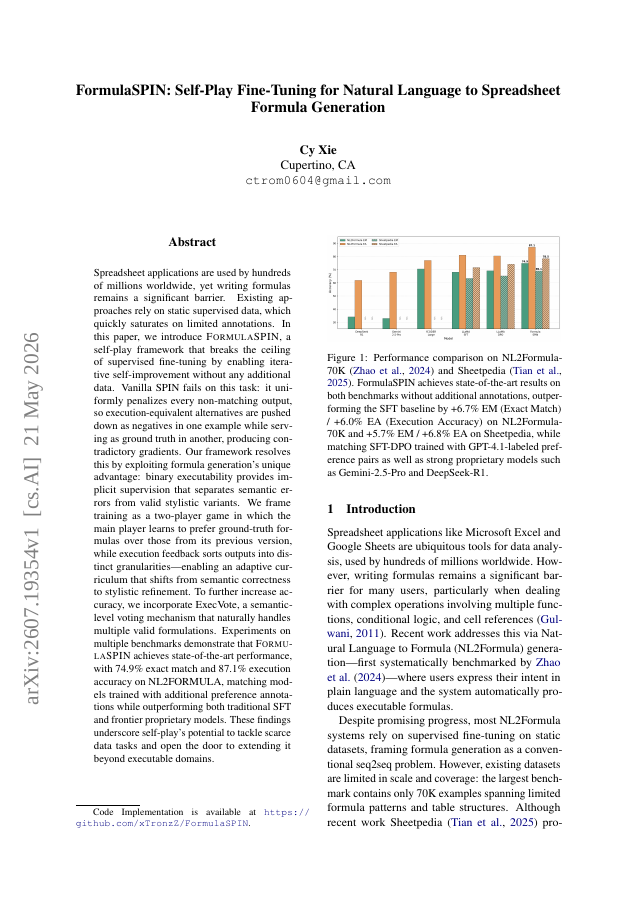
Spreadsheet applications are used by hundreds of millions worldwide, yet writing formulas remains a significant barrier. Existing approaches rely on static supervised data, which quickly saturates on limited annotations. In this paper, we introduce FORMULASPIN, a self-play framework that breaks the ceiling of supervised fine-tuning by enabling iterative self-improvement without any additional data. Vanilla SPIN fails on this task: it uniformly penalizes every non-matching output, so execution-equivalent alternatives are punished as negatives in one example while serving as ground truth in another, producing contradictory gradients. Our framework resolves this by exploiting formula generation's unique advantage: binary executability provides implicit supervision that separates semantic errors from valid stylistic variants. We frame training as a two-player game in which the main player learns to prefer ground-truth formulas over those from its previous version, while execution feedback sorts outputs into distinct granularities-enabling an adaptive curriculum that shifts from semantic correctness to stylistic refinement. To further increase accuracy, we incorporate ExecVote, a semantic-level voting mechanism that naturally handles multiple valid formulations. Experiments on multiple benchmarks demonstrate that FORMULASPIN achieves state-of-the-art performance, with 74.9% exact match and 87.1% execution accuracy on NL2FORMULA, matching models trained with additional preference annotations while outperforming both traditional SFT and frontier proprietary models. These findings underscore self-play's potential to tackle scarce data tasks and open the door to extending it beyond executable domains.
FormulaSPIN: Self-Play Fine-Tuning for Natural Language to Spreadsheet Formula Generation
Spreadsheet applications are used by hundreds of millions worldwide, yet writing formulas remains a significant barrier. Existing approaches rely on static supervised data, which quickly saturates on limited annotations.
- Preview
- Year
- 2026
- Hosting
- Abstract onlyARXIV-DEFAULT
Cite
Notes
Only stored in your browser.
Attribution
- Abstract & full text
- arxiv.org/abs/2607.19354ARXIV-DEFAULT
- TL;DR
- Semantic Scholar