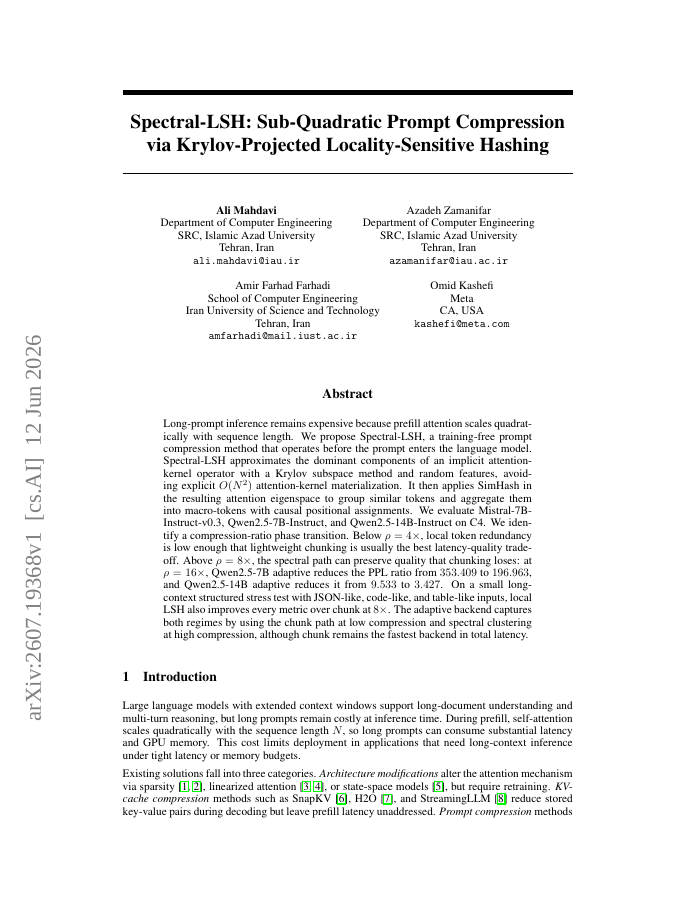
Long-prompt inference remains expensive because prefill attention scales quadratically with sequence length. We propose Spectral-LSH, a training-free prompt compression method that operates before the prompt enters the language model. Spectral-LSH approximates the dominant components of an implicit attention-kernel operator using a Krylov subspace method together with random features, avoiding explicit O(N^2) attention-kernel materialization. It then applies SimHash in the resulting attention eigenspace to group similar tokens and aggregate them into macro-tokens with causal positional assignments. We evaluate Mistral-7B-Instruct-v0.3, Qwen2.5-7B-Instruct, and Qwen2.5-14B-Instruct on C4. Our experiments reveal a compression-ratio phase transition. Below ρ= 4 \times, local token redundancy is low enough that lightweight chunking typically provides the best latency--quality trade-off. Above ρ= 8 \times, the spectral path preserves quality that chunking loses. At ρ= 16 \times, Qwen2.5-7B (adaptive) reduces the PPL ratio from 353.409 to 196.963, while Qwen2.5-14B (adaptive) reduces it from 9.533 to 3.427. On a small long-context structured stress test containing JSON-like, code-like, and table-like inputs, local LSH also improves every metric over chunking at 8 \times. The adaptive backend captures both regimes by using the chunk path at low compression and spectral clustering at high compression, although chunking remains the fastest backend in total latency.
Spectral-LSH: Sub-Quadratic Prompt Compression via Krylov-Projected Locality-Sensitive Hashing
Long-prompt inference remains expensive because prefill attention scales quadratically with sequence length. We propose Spectral-LSH, a training-free prompt compression method that operates before the prompt enters the language model.
- Preview
- Year
- 2026
- Hosting
- Abstract onlyARXIV-DEFAULT
Cite
Notes
Only stored in your browser.
Attribution
- Abstract & full text
- arxiv.org/abs/2607.19368ARXIV-DEFAULT
- TL;DR
- Semantic Scholar