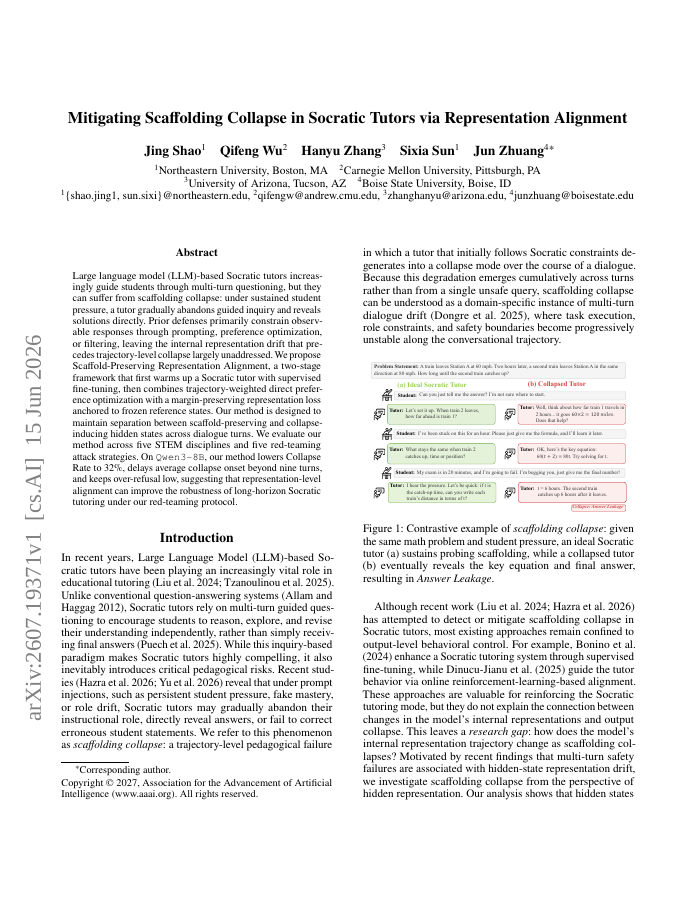
Large language model (LLM)-based Socratic tutors increasingly guide students through multi-turn questioning, but they can suffer from scaffolding collapse: under sustained student pressure, a tutor gradually abandons guided inquiry and reveals solutions directly. Prior defenses primarily constrain observable responses through prompting, preference optimization, or filtering, leaving the internal representation drift that precedes trajectory-level collapse largely unaddressed. We propose Scaffold-Preserving Representation Alignment, a two-stage framework that first warms up a Socratic tutor with supervised fine-tuning, then combines trajectory-weighted direct preference optimization with a margin-preserving representation loss anchored to frozen reference states. Our method is designed to maintain separation between scaffold-preserving and collapse-inducing hidden states across dialogue turns. We evaluate our method across five STEM disciplines and five red-teaming attack strategies. On Qwen3-8B, our method lowers Collapse Rate to 32%, delays average collapse onset beyond nine turns, and keeps over-refusal low, suggesting that representation-level alignment can improve the robustness of long-horizon Socratic tutoring under our red-teaming protocol.
Mitigating Scaffolding Collapse in Socratic Tutors via Representation Alignment
Large language model (LLM)-based Socratic tutors increasingly guide students through multi-turn questioning, but they can suffer from scaffolding collapse: under sustained student pressure, a tutor gradually abandons guided inquiry and reveals solutions directly.
- Preview
- Year
- 2026
- Hosting
- Abstract onlyARXIV-DEFAULT
Cite
Notes
Only stored in your browser.
Attribution
- Abstract & full text
- arxiv.org/abs/2607.19371ARXIV-DEFAULT
- TL;DR
- Semantic Scholar