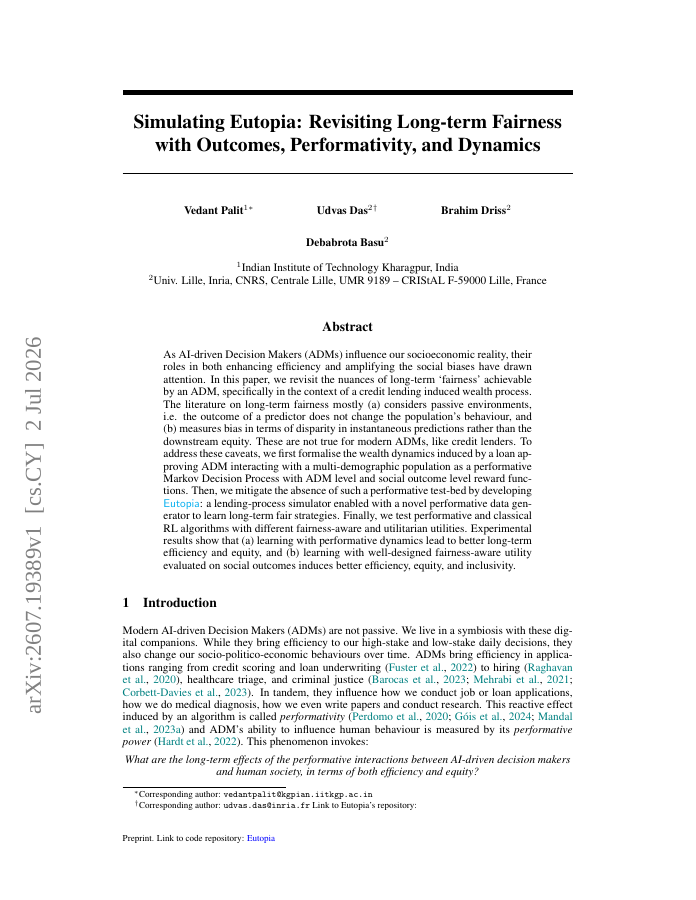
As AI-driven Decision Makers (ADMs) influence our socioeconomic reality, their roles in both enhancing efficiency and amplifying the social biases have drawn attention. In this paper, we revisit the nuances of long-term `fairness' achievable by an ADM, specifically in the context of a credit lending induced wealth process. The literature on long-term fairness mostly (a) considers passive environments, i.e. the outcome of a predictor does not change the population's behaviour, and (b) measures bias in terms of disparity in instantaneous predictions rather than the downstream equity. These are not true for modern ADMs, like credit lenders. To address these caveats, we first formalise the wealth dynamics induced by a loan approving ADM interacting with a multi-demographic population as a performative Markov Decision Process with ADM level and social outcome level reward functions. Then, we mitigate the absence of such a performative test-bed by developing Eutopia: a lending-process simulator enabled with a novel performative data generator to learn long-term fair strategies. Finally, we test performative and classical RL algorithms with different fairness-aware and utilitarian utilities. Experimental results show that (a) learning with performative dynamics lead to better long-term efficiency and equity, and (b) learning with well-designed fairness-aware utility evaluated on social outcomes induces better efficiency, equity, and inclusivity.
Simulating Eutopia: Revisiting Long-term Fairness with Outcomes, Performativity, and Dynamics
As AI-driven Decision Makers (ADMs) influence our socioeconomic reality, their roles in both enhancing efficiency and amplifying the social biases have drawn attention. In this paper, we revisit the nuances of long-term `fairness' achievable by an ADM, specifically in the…
- Preview
- Year
- 2026
- Hosting
- Full text hostedCC-BY-4.0
Cite
Notes
Only stored in your browser.
Attribution
- Abstract & full text
- arxiv.org/abs/2607.19389CC-BY-4.0
- TL;DR
- Semantic Scholar