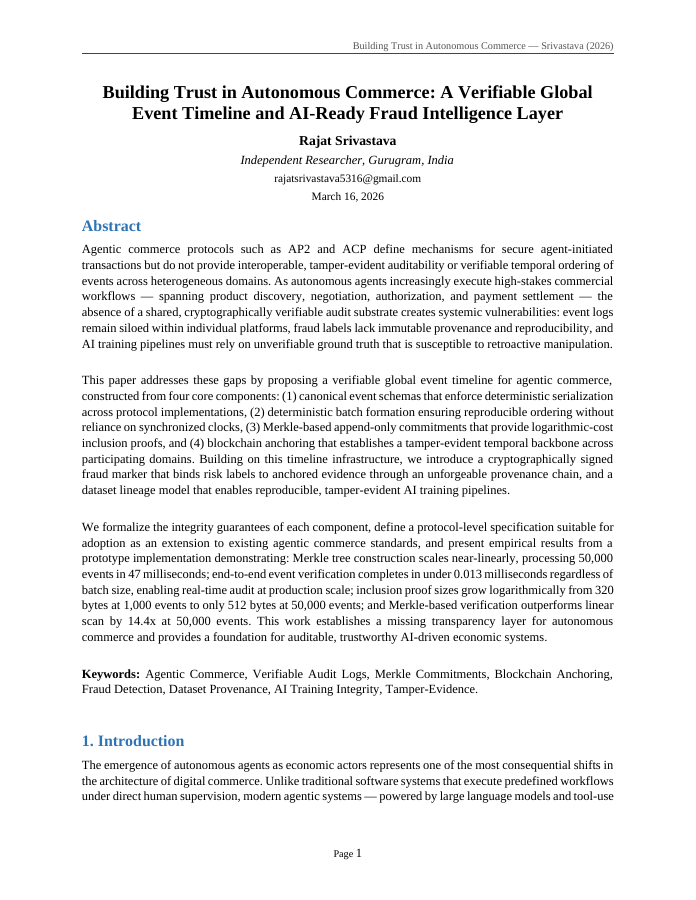
Agentic commerce protocols such as AP2 and ACP define mechanisms for secure agent-initiated transactions but do not provide interoperable, tamper-evident auditability or verifiable temporal ordering of events across heterogeneous domains. This paper addresses these gaps by proposing a verifiable global event timeline for agentic commerce, constructed from four core components: canonical event schemas that enforce deterministic serialization, deterministic batch formation ensuring reproducible ordering without reliance on synchronized clocks, Merkle-based append-only commitments providing logarithmic-cost inclusion proofs, and blockchain anchoring establishing a tamper-evident temporal backbone. Building on this infrastructure, we introduce a cryptographically signed fraud marker that binds risk labels to anchored evidence through an unforgeable provenance chain, and a dataset lineage model enabling reproducible, tamper-evident AI training pipelines. Empirical results from a prototype implementation demonstrate: Merkle tree construction processes 50,000 events in 47 milliseconds; end-to-end verification completes in under 0.013 milliseconds regardless of batch size; inclusion proof sizes grow logarithmically from 320 bytes at 1,000 events to 512 bytes at 50,000 events; and Merkle-based verification outperforms linear scan by 14.4x at 50,000 events.
Building Trust in Autonomous Commerce: A Verifiable Global Event Timeline and AI-Ready Fraud Intelligence Layer
Agentic commerce protocols such as AP2 and ACP define mechanisms for secure agent-initiated transactions but do not provide interoperable, tamper-evident auditability or verifiable temporal ordering of events across heterogeneous domains.
- Preview
- Year
- 2026
- Hosting
- Full text hostedCC-BY-4.0
Cite
Notes
Only stored in your browser.
Attribution
- Abstract & full text
- arxiv.org/abs/2607.19436CC-BY-4.0
- TL;DR
- Semantic Scholar