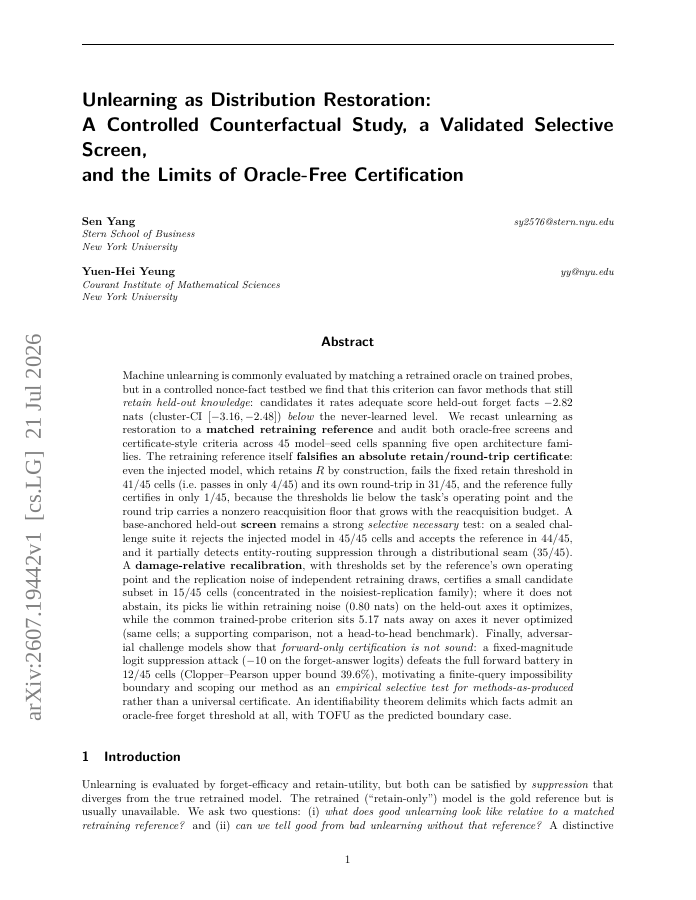
Machine unlearning is commonly evaluated by matching a retrained oracle on trained probes. In a controlled nonce-fact testbed with a matched retraining reference, we find this criterion can favor methods that retain held-out knowledge: candidates it rates adequate score held-out forget facts -2.82 nats below the never-learned level (cluster CI [-3.16,-2.48]). We recast unlearning as restoration to the matched reference and audit oracle-free screens and certificate-style criteria across 45 model-seed cells spanning five open architecture families. The reference itself falsifies an absolute retain/round-trip certificate: the injected model, which retains the retain set by construction, fails the fixed retain threshold in 41/45 cells and its own round trip in 31/45, and the reference fully certifies in only 1/45. A base-anchored held-out screen remains strong as a selective necessary test: on a sealed challenge suite it rejects the injected model in 45/45 cells, accepts the reference in 44/45, and partially detects entity-routing suppression (35/45); it is a necessary test with measured sensitivity, not a sufficiency certificate. A damage-relative recalibration anchored to the reference's own operating point certifies a small subset in 15/45 cells; where it does not abstain, its picks lie within retraining noise (0.80 nats) on the axes it optimizes, while the common trained-probe criterion sits 5.17 nats away (a supporting comparison, not a head-to-head benchmark). A fixed-magnitude logit-suppression attack defeats the full forward battery in 12/45 cells, so forward-only certification is not sound; our method is an empirical selective test for methods-as-produced. An identifiability theorem delimits which facts admit an oracle-free forget threshold at all, with TOFU as the predicted boundary case.
Unlearning as Distribution Restoration: A Controlled Counterfactual Study, a Validated Selective Screen, and the Limits of Oracle-Free Certification
Machine unlearning is commonly evaluated by matching a retrained oracle on trained probes. In a controlled nonce-fact testbed with a matched retraining reference, we find this criterion can favor methods that retain held-out knowledge: candidates it rates adequate score held-out…
- Preview
- Year
- 2026
- Hosting
- Full text hostedCC-BY-4.0
Cite
Notes
Only stored in your browser.
Attribution
- Abstract & full text
- arxiv.org/abs/2607.19442CC-BY-4.0
- TL;DR
- Semantic Scholar