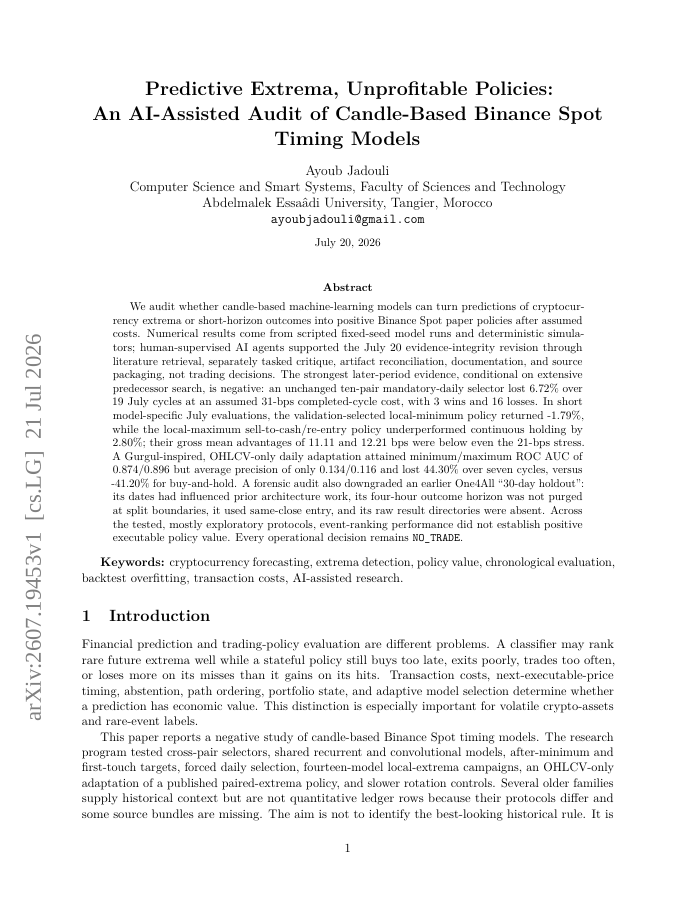
We audit whether candle-based machine-learning models can turn predictions of cryptocurrency extrema or short-horizon outcomes into positive Binance Spot paper policies after assumed costs. Numerical results come from scripted fixed-seed model runs and deterministic simulators; human-supervised AI agents supported the July 20 evidence-integrity revision through literature retrieval, separately tasked critique, artifact reconciliation, documentation, and source packaging, not trading decisions. The strongest later-period evidence, conditional on extensive predecessor search, is negative: an unchanged ten-pair mandatory-daily selector lost 6.72% over 19 July cycles at an assumed 31-bps completed-cycle cost, with 3 wins and 16 losses. In short model-specific July evaluations, the validation-selected local-minimum policy returned -1.79%, while the local-maximum sell-to-cash/re-entry policy underperformed continuous holding by 2.80%; their gross mean advantages of 11.11 and 12.21 bps were below even the 21-bps stress. A Gurgul-inspired, OHLCV-only daily adaptation attained minimum/maximum ROC AUC of 0.874/0.896 but average precision of only 0.134/0.116 and lost 44.30% over seven cycles, versus -41.20% for buy-and-hold. A forensic audit also downgraded an earlier One4All "30-day holdout": its dates had influenced prior architecture work, its four-hour outcome horizon was not purged at split boundaries, it used same-close entry, and its raw result directories were absent. Across the tested, mostly exploratory protocols, event-ranking performance did not establish positive executable policy value. Every operational decision remains NO_TRADE.
Predictive Extrema, Unprofitable Policies: An AI-Assisted Audit of Candle-Based Binance Spot Timing Models
We audit whether candle-based machine-learning models can turn predictions of cryptocurrency extrema or short-horizon outcomes into positive Binance Spot paper policies after assumed costs.
- Preview
- Year
- 2026
- Hosting
- Excerpt onlyCC-BY-NC-SA-4.0
Cite
Notes
Only stored in your browser.
Attribution
- Abstract & full text
- arxiv.org/abs/2607.19453CC-BY-NC-SA-4.0
- TL;DR
- Semantic Scholar