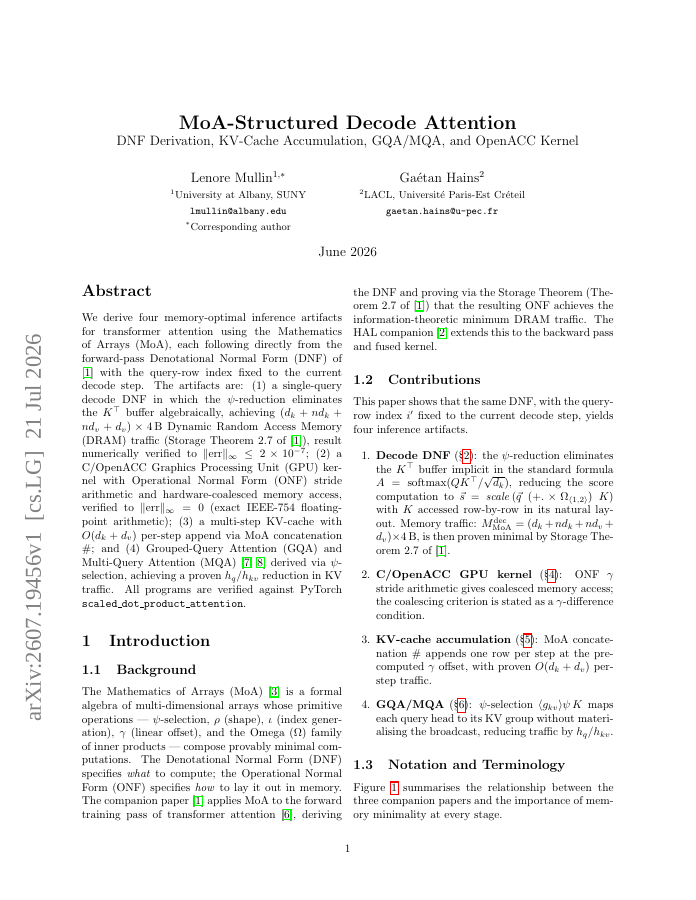
We derive four memory-optimal inference artifacts for transformer attention using the Mathematics of Arrays (MoA), each following directly from the forward-pass Denotational Normal Form (DNF) of with the query-row index fixed to the current decode step. The artifacts are: (1) a single-query decode DNF in which the ψ-reduction eliminates the K^\top buffer algebraically, achieving (d_k + nd_k+ nd_v+ d_v)\times4,{B} Dynamic Random Access Memory (DRAM) traffic result numerically verified to |{err}|\leq2\times10^{-7}; (2) a C/OpenACC Graphics Processing Unit (GPU) kernel with Operational Normal Form (ONF) stride arithmetic and hardware-coalesced memory access, verified to |err|\infty=0 (exact IEEE-754 floating-point arithmetic); (3) a multi-step KV-cache with O(d_k+d_v) per-step append via MoA concatenation #; and (4) Grouped-Query Attention (GQA) and Multi-Query Attention (MQA) derived via ψ-selection, achieving a proven \frac {h_q} { h_{kv} } reduction in KV traffic. All programs are verified against PyTorch scaled_dot_product_attention.
MoA-Structured Decode Attention DNF Derivation, KV-Cache Accumulation, GQA/MQA, and OpenACC Kernel
We derive four memory-optimal inference artifacts for transformer attention using the Mathematics of Arrays (MoA), each following directly from the forward-pass Denotational Normal Form (DNF) of with the query-row index fixed to the current decode step.
- Preview
- Year
- 2026
- Hosting
- Excerpt onlyCC-BY-NC-4.0
Cite
Notes
Only stored in your browser.
Attribution
- Abstract & full text
- arxiv.org/abs/2607.19456CC-BY-NC-4.0
- TL;DR
- Semantic Scholar