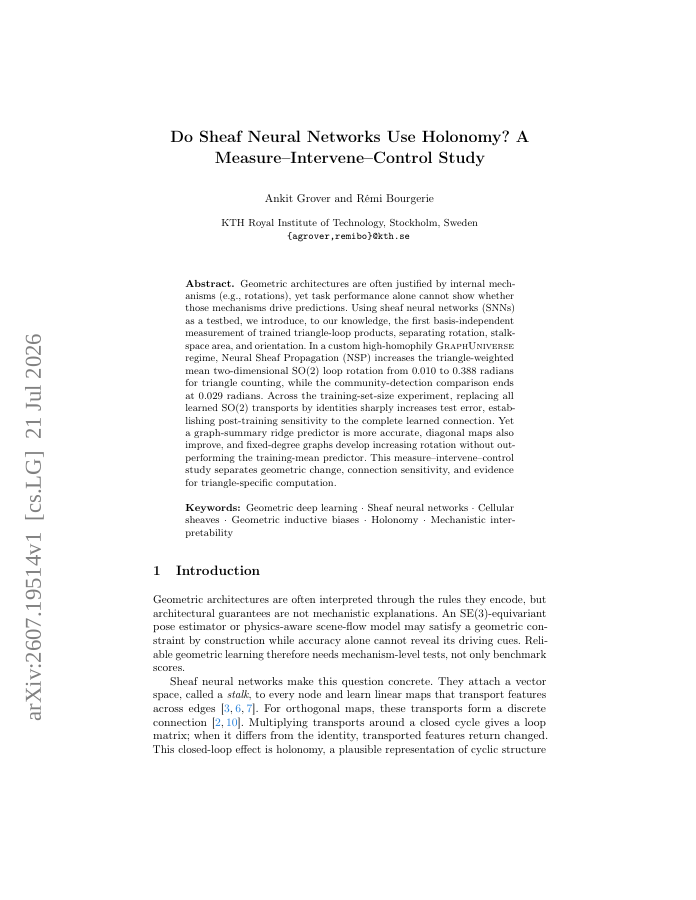
Geometric architectures are often justified by internal mechanisms such as rotations, yet task performance alone cannot show whether those mechanisms drive predictions. Using sheaf neural networks (SNNs) as a testbed, we introduce the first basis-independent measurement of trained triangle-loop products, separating rotation, stalk-space area, and orientation. In a custom high-homophily GraphUniverse regime, Neural Sheaf Propagation (NSP) increases the triangle-weighted mean two-dimensional SO(2) loop rotation from 0.010 to 0.388 radians for triangle counting, while the community-detection comparison ends at 0.029 radians. Across the training-set-size experiment, replacing all learned SO(2) transports with identities sharply increases test error, establishing post-training sensitivity to the complete learned connection. However, a graph-summary ridge predictor is more accurate, diagonal maps also improve, and fixed-degree graphs develop increasing rotation without outperforming the training-mean predictor. This measure-intervene-control study separates geometric change, connection sensitivity, and evidence for triangle-specific computation.
Do Sheaf Neural Networks Use Holonomy? A Measure--Intervene--Control Study
Geometric architectures are often justified by internal mechanisms such as rotations, yet task performance alone cannot show whether those mechanisms drive predictions. Using sheaf neural networks (SNNs) as a testbed, we introduce the first basis-independent measurement of…
- Preview
- Year
- 2026
- Hosting
- Full text hostedCC-BY-4.0
Cite
Notes
Only stored in your browser.
Attribution
- Abstract & full text
- arxiv.org/abs/2607.19514CC-BY-4.0
- TL;DR
- Semantic Scholar