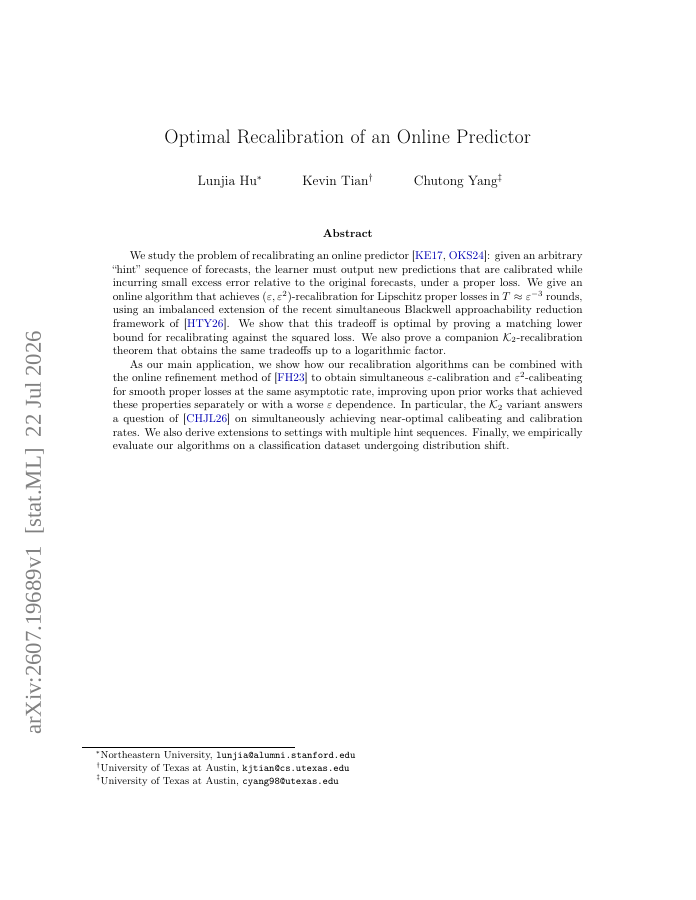
We study the problem of recalibrating an online predictor [KE17, OKS24]: given an arbitrary "hint" sequence of forecasts, the learner must output new predictions that are calibrated while incurring small excess error relative to the original forecasts, under a proper loss. We give an online algorithm that achieves (\varepsilon, \varepsilon^2)-recalibration for Lipschitz proper losses in T \approx \varepsilon^{-3} rounds, using an imbalanced extension of the recent simultaneous Blackwell approachability reduction framework of [HTY26]. We show that this tradeoff is optimal by proving a matching lower bound for recalibrating against the squared loss. We also prove a companion K_2-recalibration theorem that obtains the same tradeoffs up to a logarithmic factor. As our main application, we show how our recalibration algorithms can be combined with the online refinement method of [FH23] to obtain simultaneous \varepsilon-calibration and \varepsilon^2-calibeating for smooth proper losses at the same asymptotic rate, improving upon prior works that achieved these properties separately or with a worse \varepsilon dependence. In particular, the K_2 variant answers a question of [CHJL26] on simultaneously achieving near-optimal calibeating and calibration rates. We also derive extensions to settings with multiple hint sequences. Finally, we empirically evaluate our algorithms on a classification dataset undergoing distribution shift.
Optimal Recalibration of an Online Predictor
We study the problem of recalibrating an online predictor [KE17, OKS24]: given an arbitrary "hint" sequence of forecasts, the learner must output new predictions that are calibrated while incurring small excess error relative to the original forecasts, under a proper…
- Preview
- Year
- 2026
- Hosting
- Abstract onlyARXIV-DEFAULT
Cite
Notes
Only stored in your browser.
Attribution
- Abstract & full text
- arxiv.org/abs/2607.19689ARXIV-DEFAULT
- TL;DR
- Semantic Scholar