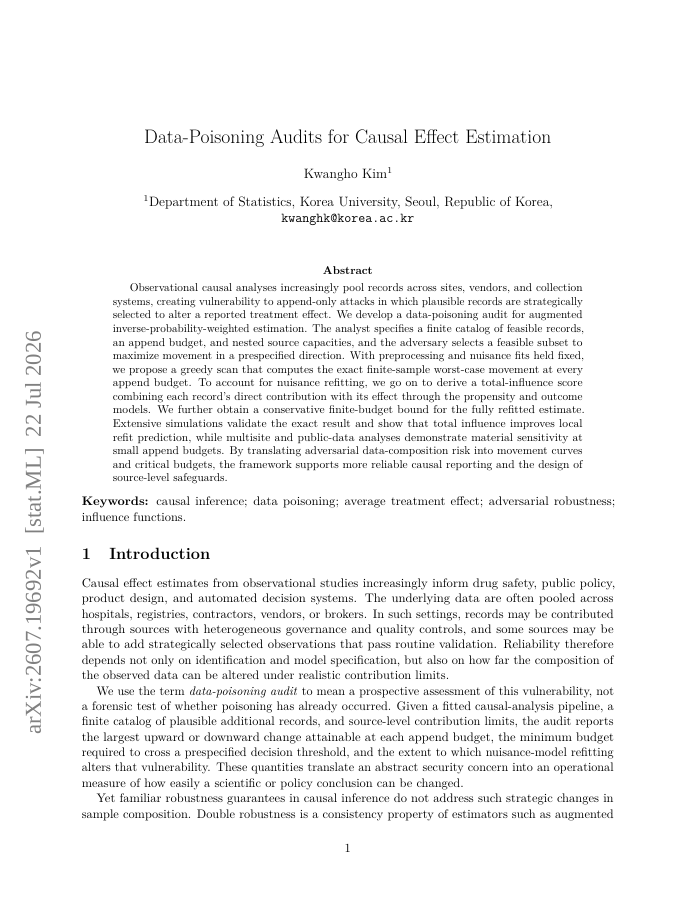
Observational causal analyses increasingly pool records across sites, vendors, and collection systems, creating vulnerability to append-only attacks in which plausible records are strategically selected to alter a reported treatment effect. We develop a data-poisoning audit for augmented inverse-probability-weighted estimation. The analyst specifies a finite catalog of feasible records, an append budget, and nested source capacities, and the adversary selects a feasible subset to maximize movement in a prespecified direction. With preprocessing and nuisance fits held fixed, we propose a greedy scan that computes the exact finite-sample worst-case movement at every append budget. To account for nuisance refitting, we go on to derive a total-influence score combining each record's direct contribution with its effect through the propensity and outcome models. We further obtain a conservative finite-budget bound for the fully refitted estimate. Extensive simulations validate the exact result and show that total influence improves local refit prediction, while multisite and public-data analyses demonstrate material sensitivity at small append budgets. By translating adversarial data-composition risk into movement curves and critical budgets, the framework supports more reliable causal reporting and the design of source-level safeguards.
Data-Poisoning Audits for Causal Effect Estimation
Observational causal analyses increasingly pool records across sites, vendors, and collection systems, creating vulnerability to append-only attacks in which plausible records are strategically selected to alter a reported treatment effect.
- Preview
- Year
- 2026
- Hosting
- Abstract onlyARXIV-DEFAULT
Cite
Notes
Only stored in your browser.
Attribution
- Abstract & full text
- arxiv.org/abs/2607.19692ARXIV-DEFAULT
- TL;DR
- Semantic Scholar