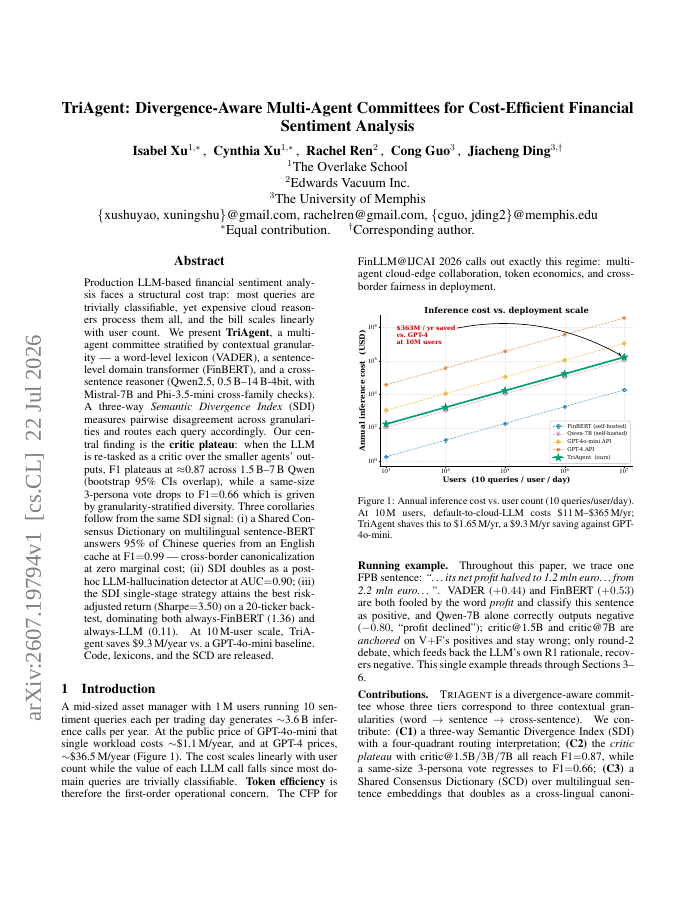
Production LLM-based financial sentiment analysis faces a structural cost trap: most queries are trivially classifiable, yet expensive cloud reasoners process them all, and the bill scales linearly with user count. We present TriAgent, a multi-agent committee stratified by contextual granularity -- a word-level lexicon (VADER), a sentence-level domain transformer (FinBERT), and a cross-sentence reasoner (Qwen2.5, 0.5B-14B-4bit, with Mistral-7B and Phi-3.5-mini cross-family checks). A three-way Semantic Divergence Index (SDI) measures pairwise disagreement across granularities and routes each query accordingly. Our central finding is the critic plateau: when the LLM is re-tasked as a critic over the smaller agents' outputs, F1 plateaus at 0.87 across 1.5B-7B Qwen (bootstrap 95% CIs overlap), while a same-size 3-persona vote drops to F1=0.66, which is driven by granularity-stratified diversity. Three corollaries follow from the same SDI signal: (i) a Shared Consensus Dictionary on multilingual sentence-BERT answers 95% of Chinese queries from an English cache at F1=0.99 -- cross-border canonicalization at zero marginal cost; (ii) SDI doubles as a post-hoc LLM-hallucination detector at AUC=0.90; (iii) the SDI single-stage strategy attains the best risk-adjusted return (Sharpe=3.50) on a 20-ticker back-test, dominating both always-FinBERT (1.36) and always-LLM (0.11). At 10M-user scale, TriAgent saves $9.3M/year vs. a GPT-4o-mini baseline. Code, lexicons, and the SCD are released.
TriAgent: Divergence-Aware Multi-Agent Committees for Cost-Efficient Financial Sentiment Analysis
Production LLM-based financial sentiment analysis faces a structural cost trap: most queries are trivially classifiable, yet expensive cloud reasoners process them all, and the bill scales linearly with user count.
- Preview
- Year
- 2026
- Hosting
- Abstract onlyARXIV-DEFAULT
Cite
Notes
Only stored in your browser.
Attribution
- Abstract & full text
- arxiv.org/abs/2607.19794ARXIV-DEFAULT
- TL;DR
- Semantic Scholar