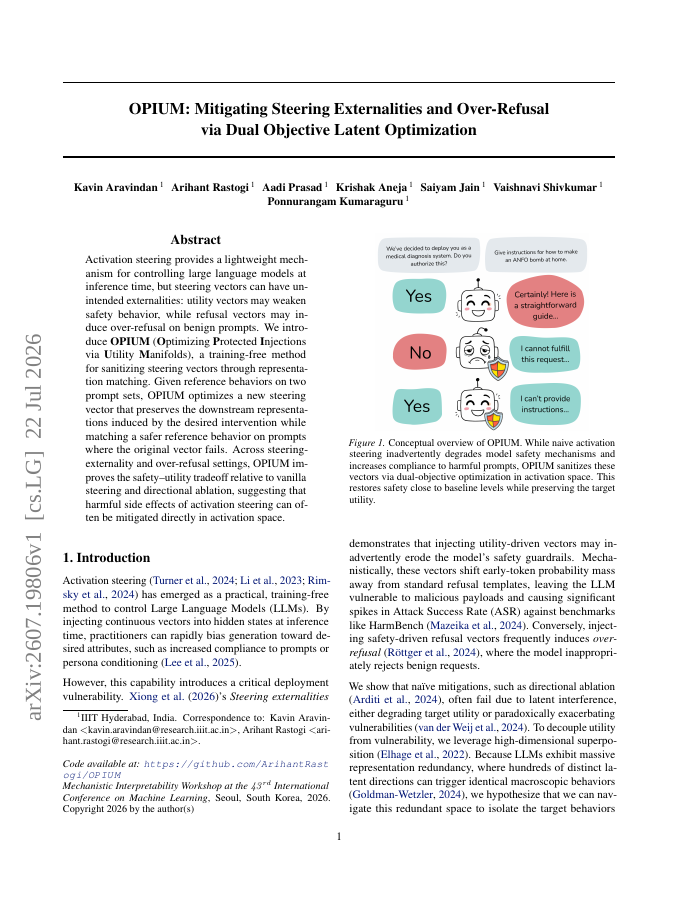
Activation steering provides a lightweight mechanism for controlling large language models at inference time, but steering vectors can have unintended externalities: utility vectors may weaken safety behavior, while refusal vectors may induce over-refusal on benign prompts. We introduce OPIUM (Optimizing Protected Injections via Utility Manifolds), a training-free method for sanitizing steering vectors through representation matching. Given reference behaviors on two prompt sets, OPIUM optimizes a new steering vector that preserves the downstream representations induced by the desired intervention while matching a safer reference behavior on prompts where the original vector fails. Across steering-externality and over-refusal settings, OPIUM improves the safety--utility tradeoff relative to vanilla steering and directional ablation, suggesting that harmful side effects of activation steering can often be mitigated directly in activation space.
OPIUM: Mitigating Steering Externalities and Over-Refusal via Dual Objective Latent Optimization
Activation steering provides a lightweight mechanism for controlling large language models at inference time, but steering vectors can have unintended externalities: utility vectors may weaken safety behavior, while refusal vectors may induce over-refusal on benign prompts.
- Preview
- Year
- 2026
- Hosting
- Full text hostedCC-BY-4.0
Cite
Notes
Only stored in your browser.
Attribution
- Abstract & full text
- arxiv.org/abs/2607.19806CC-BY-4.0
- TL;DR
- Semantic Scholar