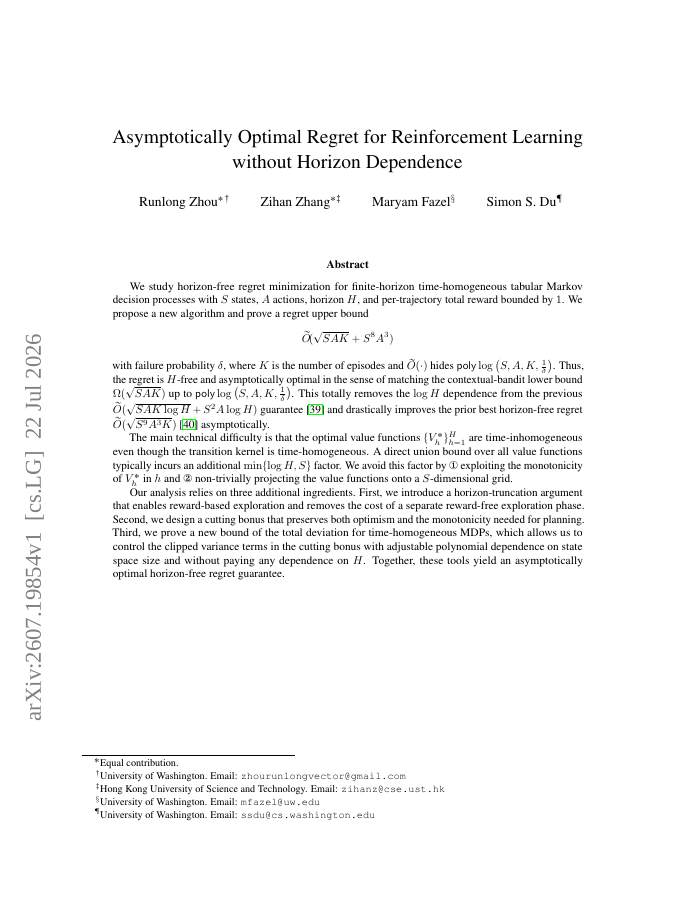
We study horizon-free regret minimization for finite-horizon time-homogeneous tabular Markov decision processes with S states, A actions, horizon H, and per-trajectory total reward bounded by 1. We propose a new algorithm and prove a regret upper bound [\tilde O(\sqrt{SAK}+S^8A^3)] with failure probability δ, where K is the number of episodes and \tilde O(\cdot) hides poly\log(S,A,K,1/δ). Thus, the regret is H-free and asymptotically optimal, matching the contextual-bandit lower bound Ω(\sqrt{SAK}) up to logarithmic factors. This completely removes the \log H dependence from the previous \tilde O(\sqrt{SAK\log H}+S^2A\log H) guarantee of Zhang et al. (2021), and drastically improves the prior best horizon-free regret \tilde O(\sqrt{S^9A^3K}) of Zhang et al. (2022) asymptotically. The main technical difficulty is that the optimal value functions {V_h^}_{h=1}^H are time-inhomogeneous even though the transition kernel is time-homogeneous. A direct union bound over all value functions typically incurs an additional \min{\log H,S} factor. We avoid this factor by (i) exploiting the monotonicity of V_h^ in h and (ii) non-trivially projecting the value functions onto an S-dimensional grid. Our analysis relies on three additional ingredients. First, we introduce a horizon-truncation argument that enables reward-based exploration and removes the cost of a separate reward-free exploration phase. Second, we design a cutting bonus that preserves both optimism and the monotonicity needed for planning. Third, we prove a new bound on total deviation for time-homogeneous MDPs, which controls the clipped variance terms in the cutting bonus with adjustable polynomial dependence on S and without any dependence on H. Together, these tools yield an asymptotically optimal horizon-free regret guarantee.
Asymptotically Optimal Regret for Reinforcement Learning without Horizon Dependence
We study horizon-free regret minimization for finite-horizon time-homogeneous tabular Markov decision processes with $S$ states, $A$ actions, horizon $H$, and per-trajectory total reward bounded by $1$.
- Preview
- Year
- 2026
- Hosting
- Abstract onlyARXIV-DEFAULT
Cite
Notes
Only stored in your browser.
Attribution
- Abstract & full text
- arxiv.org/abs/2607.19854ARXIV-DEFAULT
- TL;DR
- Semantic Scholar