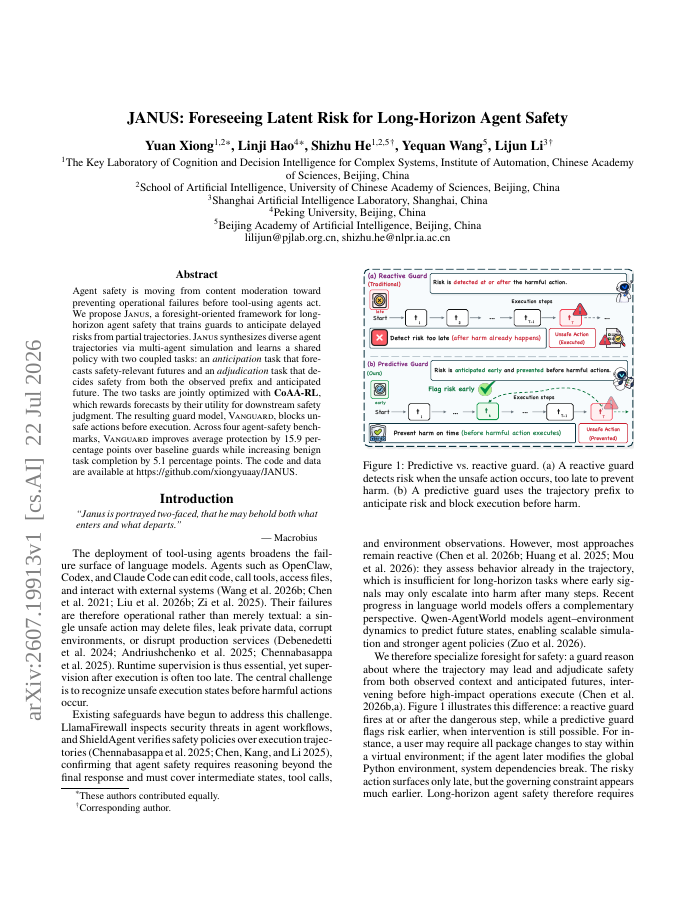
Agent safety is moving from content moderation toward preventing operational failures before tool-using agents act. We propose Janus, a foresight-oriented framework for long-horizon agent safety that trains guards to anticipate delayed risks from partial trajectories. Janus synthesizes diverse agent trajectories via multi-agent simulation and learns a shared policy with two coupled tasks: an anticipation task that forecasts safety-relevant futures and an adjudication task that decides safety from both the observed prefix and anticipated future. The two tasks are jointly optimized with CoAA-RL, which rewards forecasts by their utility for downstream safety judgment. The resulting guard model, Vanguard, blocks unsafe actions before execution. Across four agent-safety benchmarks, Vanguard improves average protection by 15.9 percentage points over baseline guards while increasing benign task completion by 5.1 percentage points.
JANUS: Foreseeing Latent Risk for Long-Horizon Agent Safety
Agent safety is moving from content moderation toward preventing operational failures before tool-using agents act. We propose Janus, a foresight-oriented framework for long-horizon agent safety that trains guards to anticipate delayed risks from partial trajectories.
- Preview
- Year
- 2026
- Hosting
- Full text hostedCC-BY-4.0
Cite
Notes
Only stored in your browser.
Attribution
- Abstract & full text
- arxiv.org/abs/2607.19913CC-BY-4.0
- TL;DR
- Semantic Scholar