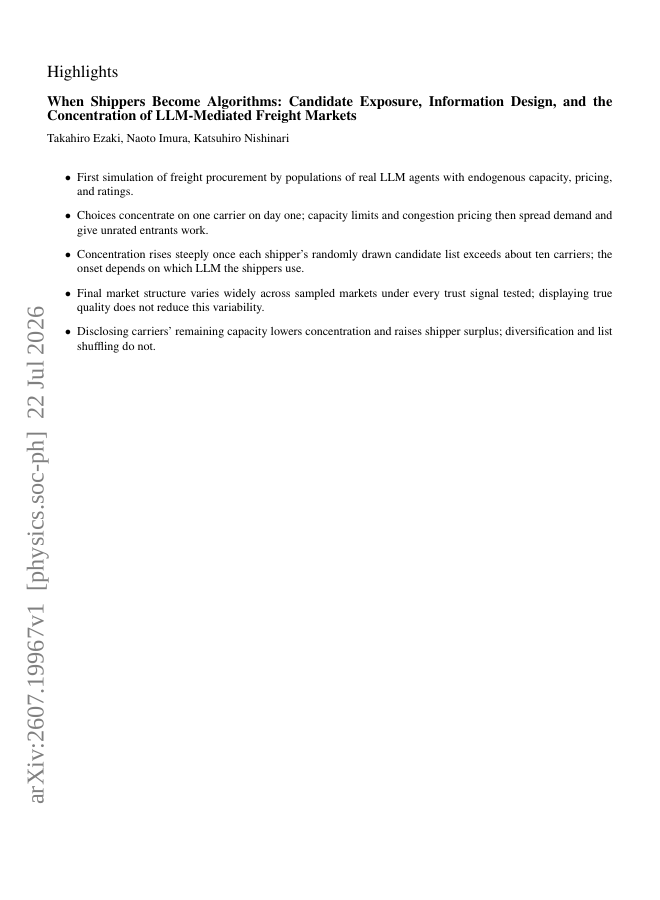
Shippers are beginning to delegate carrier selection to large language model (LLM) agents. We ask what such delegation does to a freight matching market, and which platform design choices contain it. We carried out agent-based simulations in which fifty shipper agents, built on commercial LLMs from OpenAI (GPT), Anthropic (Claude), and Google (Gemini), procure truckload capacity for thirty days. The market implements the rules of digital freight matching: each load is offered down the shipper's ranked list of carriers (waterfall tendering), carriers have daily capacity limits, spot prices respond to congestion, and carrier ratings accumulate with transactions. We found three risks and one remedy that works. Agents converged at once: for a fixed sampled carrier population, the same carrier was the modal first choice of every model on day one, attracting up to 76% of requests. Because each agent picks from its own randomly drawn list of displayed candidates, the platform controls how many options each shipper sees; concentration rose steeply once lists exceeded about ten carriers, with the onset differing across models. Which carriers ended up dominant varied widely from one sampled market to another, and displaying true quality instead of estimated ratings changed neither the level nor this variability (by design, quality affects only what agents see, never delivery outcomes). Against these risks, disclosing each carrier's remaining daily capacity cut concentration by a third and doubled shipper surplus, while vendor diversification, list-order randomization, and popularity display showed no clearly detectable effect. Platform information design, ahead of model choice or model regulation, is the lever that works.
When Shippers Become Algorithms: Candidate Exposure, Information Design, and the Concentration of LLM-Mediated Freight Markets
Shippers are beginning to delegate carrier selection to large language model (LLM) agents. We ask what such delegation does to a freight matching market, and which platform design choices contain it.
- Preview
- Year
- 2026
- Hosting
- Abstract onlyARXIV-DEFAULT
Cite
Notes
Only stored in your browser.
Attribution
- Abstract & full text
- arxiv.org/abs/2607.19967ARXIV-DEFAULT
- TL;DR
- Semantic Scholar